
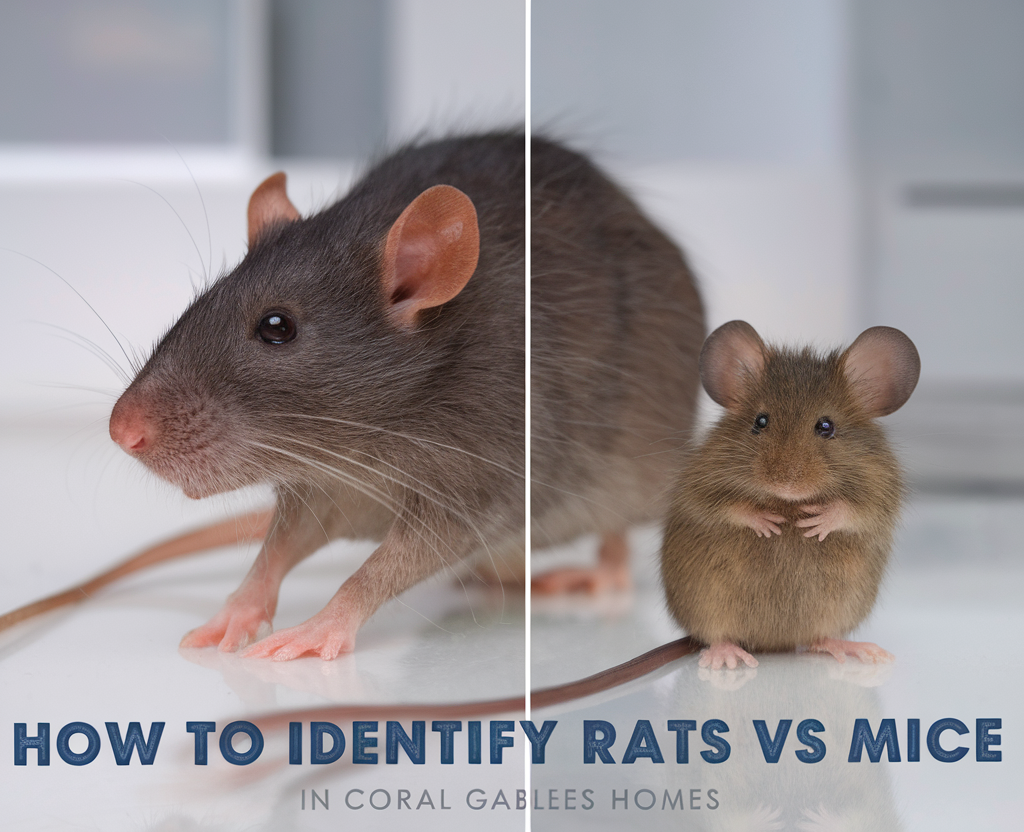
Picture this: You’re settling into your beautiful Coral Gables home for the evening, maybe pouring a glass of wine after a long day, when you hear it. That faint scratching sound coming from somewhere above you. You pause, tilting your head. There it is again. A soft scurrying that makes your stomach drop just a little.
The next morning, you’re reaching for your favorite cereal when you notice something that makes you freeze. Small, dark droppings scattered along the baseboard. A chewed corner on the box. And just like that, the question isn’t whether you have unwanted houseguests anymore. It’s what kind.
Here’s the thing: knowing whether you’re dealing with rats or mice isn’t just about satisfying your curiosity. It’s about understanding what you’re up against. These two rodents might seem similar at first glance, but they behave completely differently, pose unique threats to your home and health, and require entirely different approaches to control. For those of us living in Coral Gables, where Mediterranean architecture meets subtropical paradise, this distinction can mean the difference between a quick resolution and a months-long battle that threatens everything from your family’s health to your home’s structural integrity.
Let me walk you through what I’ve learned from years of helping homeowners just like you navigate these unsettling discoveries.
Why Your Coral Gables Home Is Rodent Paradise
I know what you’re thinking. You keep a clean home. You maintain your property. How did this happen? The truth is, Coral Gables homes attract rodents for reasons that have nothing to do with cleanliness and everything to do with the very features that make this city so beautiful.
Those gorgeous Mediterranean Revival homes with their stucco exteriors and clay tile roofs? They’re architectural masterpieces, but they also create countless little entry points that rodents exploit with remarkable efficiency. That stunning banyan tree shading your driveway? It’s basically a rodent highway leading straight to your roofline. The citrus trees dropping fruit in your backyard? An all-you-can-eat buffet that keeps them coming back.
What many homeowners don’t realize is that our South Florida climate eliminates the natural population control that northern states experience every winter. Up north, freezing temperatures knock rodent numbers down significantly each year. Here in Coral Gables, they breed continuously, twelve months a year, with populations exploding during our wet season when outdoor conditions send them searching for drier accommodations. Guess where they find it? Your attic. Your walls. Your garage.
I’ve worked with homeowners in the historic neighborhoods along Old Cutler Road and the North Gables area whose beautiful vintage properties have small gaps in their original construction, weatherstripping that’s deteriorated over decades, and foundation cracks that provide VIP access for these persistent pests. But newer developments aren’t safe either. Construction activity displaces rodent populations from their natural habitats, and they don’t just wander off. They move directly into the nearest available shelter, which often means the brand-new home you just moved into.
The canal system running through our city adds another layer of complexity. These waterways support robust rodent populations, particularly roof rats that absolutely thrive in the elevated, tree-covered environments we’ve created throughout Coral Gables. They travel along branches, leap onto rooflines, and find their way inside before you even know they’re there.
The Tale of Two Rodents: Physical Differences That Matter
So you’ve discovered evidence of rodent activity. Now comes the crucial part: figuring out exactly what you’re dealing with. Let me paint you a clearer picture of what distinguishes these two pests.
Size Tells a Story
Mice are delicate creatures, really. At just 2.5 to 3.5 inches in body length and weighing less than an ounce, they’re almost fragile-looking. The house mouse, which is what you’ll typically encounter in Coral Gables, has a light brown to gray coat and proportionate features that give it an almost cute appearance. Until you remember it’s uninvited and potentially dangerous.
Rats, on the other hand, are substantially more imposing. While Norway rats can reach 7 to 9 inches and weigh up to 18 ounces, here in Coral Gables you’re far more likely to encounter roof rats. These sleek climbers typically measure 6 to 8 inches in body length with athletic builds perfectly adapted for the acrobatic lifestyle they lead in our tree canopies and attic spaces.
The Face of Your Problem
If you do spot one of these intruders, their facial features provide immediate identification. Mice have distinctly triangular faces with pointed noses, ears that seem almost comically large for their head size, and beady little eyes that look disproportionately big. There’s something almost cartoonish about their appearance.
Rats present a completely different profile. Their faces are broader, with blunt noses, proportionally smaller ears, and eyes that fit their larger head size. There’s nothing cute or cartoonish about a rat’s face. It’s built for survival, and it shows.
Tails Never Lie
Here’s one of the easiest identification tricks I can share: look at the tail. Mouse tails are thin, covered in fine hair, and roughly equal to their body length. If you see a small rodent with a slender, somewhat hairy tail, you’re looking at a mouse.
Rat tails are impossible to mistake once you know what you’re looking for. They’re thick, scaly, and nearly hairless. Most rat tails are shorter than their body length, but roof rats (our local specialists) have tails that can actually be longer than their bodies. This helps them maintain balance while performing their high-wire acts through tree branches and along power lines. If you spot a thick, scaly tail, you’re definitely dealing with a rat.
Tracks in the Dust
Sometimes you don’t see the rodent itself, but you find its tracks. Maybe in that dusty corner of your garage or along a rarely-used pathway in your attic. Mouse tracks are tiny, almost delicate, and easy to miss without close inspection. Rat tracks are unmistakable, with hind feet that can measure up to an inch long. If you can clearly see distinct paw prints, you’re looking at evidence of rats, not mice.
Reading Their Behavior: How Rats and Mice Tell Different Stories
Even if you never actually see your unwanted houseguests, their behavior patterns tell you exactly what you’re dealing with. Understanding these differences has helped countless Coral Gables homeowners I’ve worked with identify their problem quickly and accurately.
The Curious Mouse vs The Cautious Rat
Mice are bold little explorers. They’re naturally curious, willing to investigate new objects, and surprisingly comfortable venturing into open spaces despite their vulnerability. If you’ve ever seen a mouse dart across your kitchen floor in broad daylight or brazenly investigate your countertops, you’ve witnessed this fearless nature firsthand. They’re risk-takers, which actually makes them somewhat easier to trap.
Rats are the complete opposite. They’re neophobic, meaning they’re deeply suspicious of anything new in their environment. They establish regular travel routes along walls and baseboards, and they stick to these paths religiously. Over time, their oily fur creates visible rub marks on surfaces they contact repeatedly. These dark, greasy streaks are like breadcrumbs showing you exactly where rats are traveling through your home.
Roof rats, the species dominating Coral Gables, take this caution to elevated heights, literally. They prefer pathways above ground level and avoid floor travel when alternatives exist. If you’re noticing activity in your attic, along ceiling joists, or in upper cabinets, you’re almost certainly dealing with roof rats rather than mice.
The Sound of Trouble
Those sounds that first alerted you to a problem? They’re actually quite distinctive once you know what to listen for. During quiet evenings in your Coral Gables home, mouse activity sounds like light, rapid scratching, almost like paper rustling. You might hear high-pitched squeaking during their social interactions and the soft pitter-patter of tiny feet across hard surfaces. Their movement seems erratic, exploratory, without clear patterns.
Rat sounds are heavier, more deliberate, and frankly more unsettling. The scratching and gnawing is loud enough to wake you from sleep. You’ll hear thumping and bumping sounds, especially in attics or walls. Their vocalizations include squeaks, hisses, and chattering, all lower-pitched than mice. And their movement follows consistent, repetitive patterns along their established routes.
Here’s a helpful tip: the location of sounds provides excellent identification clues. Scratching in walls at ground level or near flooring typically indicates mice. Activity in upper walls, ceilings, or attics almost always signals roof rats, the predominant rat species throughout our area.
Where They Make Themselves at Home
Mice aren’t picky about elevation. They build cozy nests from soft materials like shredded paper, fabric scraps, or insulation, tucking them into hidden spots close to food sources. In Coral Gables homes, this often means inside kitchen cabinets, tucked into bathroom vanities, or within wall voids near your pantry. They want convenience, and they want to be near their next meal.
Roof rats live up to their name. They nest above ground level, preferring attics, thick vegetation, palm trees, or along roof eaves. They want locations that provide escape routes in multiple directions because, remember, they’re cautious creatures focused on survival. The abundant ficus trees throughout Coral Gables create ideal roof rat habitats, and these athletic rodents transition effortlessly from tree canopies to your roofline without ever touching the ground.
The Droppings Don’t Lie: Your Most Reliable Clue
I know this isn’t the most pleasant topic, but rodent droppings provide one of the most reliable identification methods available. The differences are distinct and unmistakable once you know what you’re looking for.
Mouse droppings are small, measuring just 1/8 to 1/4 inch long, similar in size and shape to a grain of rice. They’re rod-shaped with pointed ends, dark brown to black when fresh, and fade to gray as they age. Mice are prolific producers, leaving 50 to 80 droppings daily, scattered somewhat randomly throughout their territory. In Coral Gables homes, you’ll typically find these along countertops, inside cabinets, near food storage areas, and behind appliances.
Rat droppings are substantially larger, measuring 1/2 to 3/4 inch long, roughly the size of a raisin or olive pit. They’re capsule-shaped with blunt ends rather than pointed, and they have a shiny appearance when fresh. Rats produce 40 to 50 droppings daily, but unlike mice, they tend to concentrate their droppings along their established travel routes. You’ll find these in attics, along beams, in corners of garages, and near wall-ceiling junctions.
An important safety note I need to emphasize: never handle rodent droppings directly, and never sweep or vacuum them dry. Both of these actions can aerosolize dangerous pathogens that cause serious diseases including Hantavirus, Leptospirosis, and Salmonellosis. Always wear gloves, spray the area thoroughly with a disinfectant solution, wait several minutes for it to soak in, then carefully clean using paper towels that you immediately dispose of in sealed plastic bags. Your health is worth these extra precautions.
The Damage They Leave Behind
Beyond droppings and sounds, the type and location of damage throughout your Coral Gables home tells a clear story about which rodent is causing problems.
Gnaw Marks That Identify the Culprit
Both rats and mice have continuously growing incisors that require constant gnawing to keep manageable. It’s not optional for them, it’s a biological necessity. But the evidence they leave differs dramatically.
Mouse gnaw marks are small, approximately 1/16 inch wide, appearing as tiny scratches on wood, plastic, or cardboard. The damage seems almost delicate, superficial. You might find nibbled corners on food packaging or small scratches on wooden surfaces.
Rat gnaw marks are impossible to miss. At approximately 1/8 inch wide, they create obvious, deep grooves on wood framing, electrical wiring, and even plumbing. This isn’t superficial damage. This is destructive force that threatens your home’s integrity.
The Hidden Danger: Electrical Damage
This is where rodent problems escalate from annoying to genuinely dangerous. Both species gnaw on electrical wiring, but rats, with their stronger jaws and larger size, cause far more severe damage. In Coral Gables homes, roof rats frequently damage attic wiring, creating serious fire hazards that most homeowners don’t discover until it’s too late.
If you notice flickering lights, circuit breakers tripping repeatedly, or any exposed wiring in your attic or walls, this demands immediate professional inspection. The potential consequences are too severe to ignore or delay.
Structural Threats
Mice typically damage insulation, stored papers, fabrics, and cardboard packaging. It’s frustrating and costly, but usually limited to replaceable items. They’re destructive, but on a smaller scale.
Rats can compromise your home’s structural elements. They chew through wooden beams, damage roof decking, destroy air conditioning ductwork, and gnaw through thin metals like aluminum flashing. For homeowners in historic Coral Gables properties where original woodwork holds both monetary and sentimental value, rat damage can be absolutely heartbreaking. These aren’t just repair costs, they’re losses of irreplaceable craftsmanship.
Outdoor Warning Signs
Walk around your Coral Gables property and you might notice these telltale signs:
Mice leave small burrows in mulched beds and minimal visible pathways. Their outdoor presence is subtle, almost easy to overlook.
Rats create visible runways through vegetation where they travel repeatedly, leave burrows under foundations or concrete slabs, and gnaw fruits directly on trees. If you have citrus, avocado, or mango trees (and who doesn’t in Coral Gables?), you might find partially eaten fruit still hanging on branches or distinctive gnaw marks on fallen fruit. That’s rats claiming your harvest before you can.
Health Risks: Why Identification Really Matters
Let’s talk about something that should concern every homeowner: the health implications of these unwanted houseguests. Both rats and mice pose genuine health risks to your family, but the specific threats differ in important ways.
Disease Concerns Specific to Each Species
Mice are primary vectors for Hantavirus, which transmits through aerosolized urine and droppings (remember that warning about not sweeping them?). They also carry Lymphocytic Choriomeningitis virus and can spread Salmonellosis through surface contamination. These are serious illnesses that can have lasting consequences.
Rats carry an even more extensive list of dangerous pathogens. Leptospirosis is particularly concerning here in Coral Gables given our waterways and the flooding we experience during wet season. They also transmit rat-bite fever, typhus through the fleas that infest them, and yes, even plague, though that’s thankfully rare. The disease burden rats carry is substantially more severe than mice.
Allergens and Respiratory Risks
Both rodents produce allergens through their urine, droppings, and dander that can trigger asthma and respiratory issues. But rats, being significantly larger, produce proportionally more allergens. For Coral Gables residents already managing asthma or respiratory sensitivities in our humid climate, a rat infestation poses more severe health consequences than a mouse problem.
The Parasites They Bring Along
Here’s something that catches many homeowners off guard: rats typically carry more parasites than mice, including fleas, mites, and ticks. These secondary pests can infest your home even after you’ve eliminated the rodents themselves, requiring additional treatment protocols. It’s like dealing with two pest problems for the price of one, except you didn’t want either.
Seasonal Patterns in Our Subtropical Paradise
Unlike our northern neighbors who experience distinct seasonal shifts in rodent pressure, we face year-round challenges here in Coral Gables. But understanding our seasonal patterns helps identify which species you’re encountering and when to be most vigilant.
Wet Season Realities (May Through October)
Our wet season brings increased rodent activity as outdoor conditions become less favorable. Heavy rains flood ground burrows, sending Norway rats upward when they’re present. Roof rats, already comfortable in elevated spaces, increasingly seek shelter in attics and roof cavities. Mice populations actually peak during this period because abundant food sources support their rapid reproduction cycles.
If you notice sudden increased activity during summer months, particularly in elevated areas of your home, you’re almost certainly dealing with roof rats rather than mice. The timing and location combination is remarkably diagnostic.
Dry Season Considerations (November Through April)
Rodent activity moderates slightly during our dry season but never truly stops. This is actually the ideal time to address vulnerabilities before wet season arrives and populations explode. Mice may become more noticeable during this period as they venture indoors seeking water sources that are less abundant outside.
Hurricane Season: A Special Challenge
Before, during, and after tropical storms, rodent activity throughout Coral Gables increases dramatically. Flooding displaces outdoor populations, vegetation damage destroys their natural habitats, and storm damage to homes creates new entry points. If you experience a sudden rodent presence following severe weather, don’t wait. Professional inspection becomes even more critical to prevent establishment of permanent indoor populations that will be exponentially harder to eliminate later.
Entry Points: How They’re Getting Inside
Understanding how rodents access your Coral Gables home helps with both identification and prevention. The entry points they exploit tell you what you’re dealing with.
Mouse Entry: Masters of Compression
Mice possess an almost supernatural ability to squeeze through openings as small as 1/4 inch, roughly the diameter of a pencil. Think about that for a moment. A quarter-inch gap. That’s smaller than you probably imagine. Common entry points in Coral Gables homes include gaps under doors and garage doors, utility penetrations where pipes and wires enter, deteriorated weatherstripping around windows, small cracks in stucco or foundation, gaps around air conditioning lines, and dryer vents without proper screening.
Walk around your home at ground level and you’ll likely find multiple potential mouse entry points you never noticed before. They’re everywhere once you start looking.
Rat Entry: Exploiting Architecture
Rats require larger openings, approximately 1/2 inch for roof rats, but they’re remarkably skilled at exploiting architectural features common throughout Coral Gables. Roof-soffit junctions where trim pieces meet, ridge vents without proper screening, damaged clay roof tiles (particularly relevant in our Mediterranean-style homes), gaps around chimney flashings, tree branches providing bridge access to rooflines, damaged foundation vents, and even open garage doors during evening hours when roof rats are bold enough to simply walk in.
The identification implication here is clear: if you’re finding rodent activity but can’t locate any entry point larger than a quarter-inch, you’re likely dealing with mice. Evidence of exploitation of larger openings, particularly at elevated locations, indicates rats taking full advantage of your home’s architectural features.
When Professional Help Becomes Essential
I believe in empowering homeowners with knowledge and understanding, but I also believe in being honest about when professional intervention becomes necessary. Certain situations demand expertise, specialized equipment, and professional-grade products that simply aren’t available to homeowners.
Immediate Red Flags
Call for professional help immediately when you notice droppings accumulating daily despite your cleaning efforts. This indicates active, established populations that are breeding faster than you can control them. If electrical damage is evident, the fire risk from gnawed wiring requires immediate professional attention, not DIY attempts. When multiple family members experience unexplained allergies or respiratory issues, the health implications warrant professional-grade elimination protocols.
If you hear activity in multiple locations throughout your home, you’re facing a widespread infestation that requires comprehensive treatment beyond what traps and consumer products can accomplish. Previous DIY control efforts that have failed signal the need for professional-grade products and expertise. If you have children or immune-compromised family members in your home, the health risks justify professional intervention. And if you’re preparing to sell your property, unaddressed rodent issues can derail real estate transactions fast.
What Professional Service Really Means
At Dade Pest Solutions, we’ve spent years understanding how Coral Gables’ unique characteristics influence rodent infestations. We don’t just identify species through visible evidence. We understand behavior patterns, seasonal influences, and architectural vulnerabilities specific to our area. That local knowledge makes an enormous difference in treatment effectiveness.
Professional treatment goes far beyond simply placing traps and hoping for the best. Comprehensive service includes identifying every entry point (and trust me, there are always more than homeowners find on their own), implementing exclusion measures tailored to your home’s specific architecture, establishing monitoring systems that track progress, and providing documentation that’s important for real estate transactions and insurance purposes.
We serve homeowners throughout Coral Gables, Country Walk, Cutler Bay, Glenvar Heights, Homestead, Kendall, Little Gables, Palmetto Bay, Pinecrest, Princeton, Redland, Richmond West, South Miami, and The Crossings. Wherever you are in Miami-Dade County, we understand your specific challenges because we live and work here too.
Prevention: Protecting Your Home Long-Term
Whether you’re currently battling rodents or working to prevent future problems, these prevention strategies address the unique conditions we face here in Coral Gables.
Landscape Management That Makes a Difference
Trim tree branches to maintain at least six feet of clearance from your rooflines. I know those shade trees are beautiful, but they’re also highways delivering roof rats directly to your home. Remove fallen fruit promptly from citrus, mango, and avocado trees. Yes, it’s extra work, but leaving rotting fruit on the ground is literally setting out a welcome buffet. Store firewood at least 20 feet from your home’s exterior, maintain a 12-inch vegetation-free zone around your foundation, eliminate dense ground cover directly adjacent to your home, and keep compost bins properly sealed and positioned away from structures.
Structural Maintenance You Can’t Ignore
After any storm activity, inspect and repair roof tiles. Even small damage creates entry opportunities. Seal all utility penetrations with appropriate materials (copper mesh for larger gaps, caulk for smaller ones). Install quality door sweeps on all exterior doors, including that garage door you might not have considered. Screen all vents, including ridge vents, soffit vents, and foundation vents. Repair deteriorated stucco and fill foundation cracks before they become doorways. Install chimney caps with appropriate mesh sizing.
Sanitation Practices That Prevent Problems
Store pet food in sealed metal or heavy plastic containers, not the bags they come in. Feed pets on schedules rather than leaving food available continuously (I know, some pets won’t like this change, but it’s important). Clean pet feeding areas immediately after meals. Store garbage in sealed containers and maintain weekly removal schedules. Keep kitchen counters free of food debris, even crumbs that seem insignificant. Store pantry items in rodent-proof containers. Address moisture issues promptly because leaking pipes, poor drainage, and high humidity attract rodents seeking water sources just as much as food.
Frequently Asked Questions From Coral Gables Homeowners
Can I have both rats and mice in my home at the same time?
It’s actually relatively uncommon. Rats are aggressive toward mice and will typically drive them out of shared territory. If you have rats established in your home, mice usually avoid the area. However, in larger properties or homes with multiple disconnected spaces, it’s theoretically possible to have both, though in our experience serving Coral Gables homeowners, you’ll typically deal with one or the other, not both simultaneously.
How quickly do rodent populations grow?
This is where things get scary. Mice can produce 5 to 10 litters per year, with 5 to 6 young per litter. They reach sexual maturity in just 6 weeks. Do the math and you’ll understand why a small mouse problem can become a major infestation in mere months. Rats reproduce slightly slower, with 3 to 6 litters per year and 6 to 10 young per litter, but they’re still incredibly prolific. This is why early intervention is so critical.
Are roof rats really more common than Norway rats in Coral Gables?
Absolutely. Roof rats dominate our area because they’re perfectly adapted to our climate, architecture, and abundant tree canopy. Norway rats prefer cooler climates and ground-level living. When we perform inspections throughout Coral Gables, Pinecrest, and South Miami, roof rats account for the vast majority of rat infestations we encounter.
Can rodents come up through toilets?
While rats are capable swimmers and there are documented cases of this happening, it’s extremely rare and mostly an urban legend that causes unnecessary anxiety. Your toilet is not a likely entry point. Focus your concerns and prevention efforts on the far more common entry points around your home’s exterior, attic, and foundation.
Do ultrasonic repellents actually work?
I wish I could tell you they do, but the honest answer is no. Despite marketing claims, scientific studies consistently show that ultrasonic devices have no significant long-term effect on rodent behavior. Rodents may avoid the area briefly when the device is first installed, but they quickly habituate and ignore the sound. Don’t waste your money. Invest in proven control methods instead.
How long does professional rodent control take?
It depends on the species and severity of infestation. Mouse control typically shows results within 1 to 2 weeks. Rat control takes longer, usually 3 to 4 weeks, because of their neophobic nature (remember, they’re suspicious of new things, including traps). Severe infestations require longer treatment periods, and ongoing monitoring ensures the problem doesn’t return. Every situation is unique, which is why we provide customized treatment timelines during our initial inspection.
Is rodent control safe for my pets and children?
Professional pest control companies like Dade Pest Solutions use methods and products that prioritize safety while maintaining effectiveness. We strategically place bait stations in locations inaccessible to children and pets, use tamper-resistant devices, and provide clear safety guidance during treatment. DIY products often lack these safety features, which is one of many reasons professional treatment is actually safer than attempting control yourself.
The Path Forward: Taking Action With Confidence
If you’ve made it this far, you now know more about rats and mice than most Coral Gables homeowners ever learn. You understand the differences, you recognize the warning signs, and you know what each species means for your home and family.
But knowledge alone doesn’t solve the problem. At some point, you need to take action.
Maybe you discovered droppings this morning. Maybe those scratching sounds kept you awake last night. Maybe you’re simply being proactive, protecting your home before problems develop. Whatever brought you here today, you deserve peace of mind. You deserve to feel safe and comfortable in your own home. You deserve to stop worrying about what’s happening in your walls, your attic, or your pantry.
At Dade Pest Solutions, we’ve built our reputation on understanding exactly what Coral Gables homeowners face. We know your Mediterranean architecture inside and out. We understand how roof rats use those beautiful ficus trees to access your home. We recognize which neighborhoods have unique vulnerabilities based on construction era and methods. This isn’t just our business, it’s our community. We live here too.
We don’t believe in one-size-fits-all solutions or high-pressure sales tactics. We believe in thorough inspections, honest assessments, and customized treatment plans that address your specific situation. Whether you’re in Coral Gables, Pinecrest, South Miami, Kendall, or anywhere throughout Miami-Dade County, we’re equipped to help you take back your home.
Every day you wait is another day these unwanted houseguests are breeding, causing damage, and potentially affecting your family’s health. I don’t say that to scare you. I say it because it’s true, and you deserve the truth.
Contact Dade Pest Solutions today for a comprehensive inspection. We’ll accurately identify which rodent species you’re dealing with, show you exactly how they’re accessing your home, implement effective control measures using professional-grade products and methods, and establish long-term prevention strategies tailored specifically to your property’s unique characteristics. Your home deserves professional protection. Your family deserves the peace of mind that comes from knowing the problem is handled correctly the first time.
You’ve done the hard part by educating yourself. Now let us handle the rest. Call us today, and let’s solve this problem together.

17 Years of Pest Control Experience Founder and Owner of Dade Pest Solutions Proud Resident of South Florida
Shaun Judy, a dedicated South Florida native, is the founder and driving force behind Dade Pest Solutions. With over 17 years of hands-on experience in the pest control industry, Shaun has built a reputation for reliability, results, and real local knowledge. His journey began with a deep commitment to protecting homes from pests using proven methods and innovative solutions. Raised with a strong work ethic and a passion for service, Shaun treats every property as if it were his own—delivering expert care with a personal touch.
