
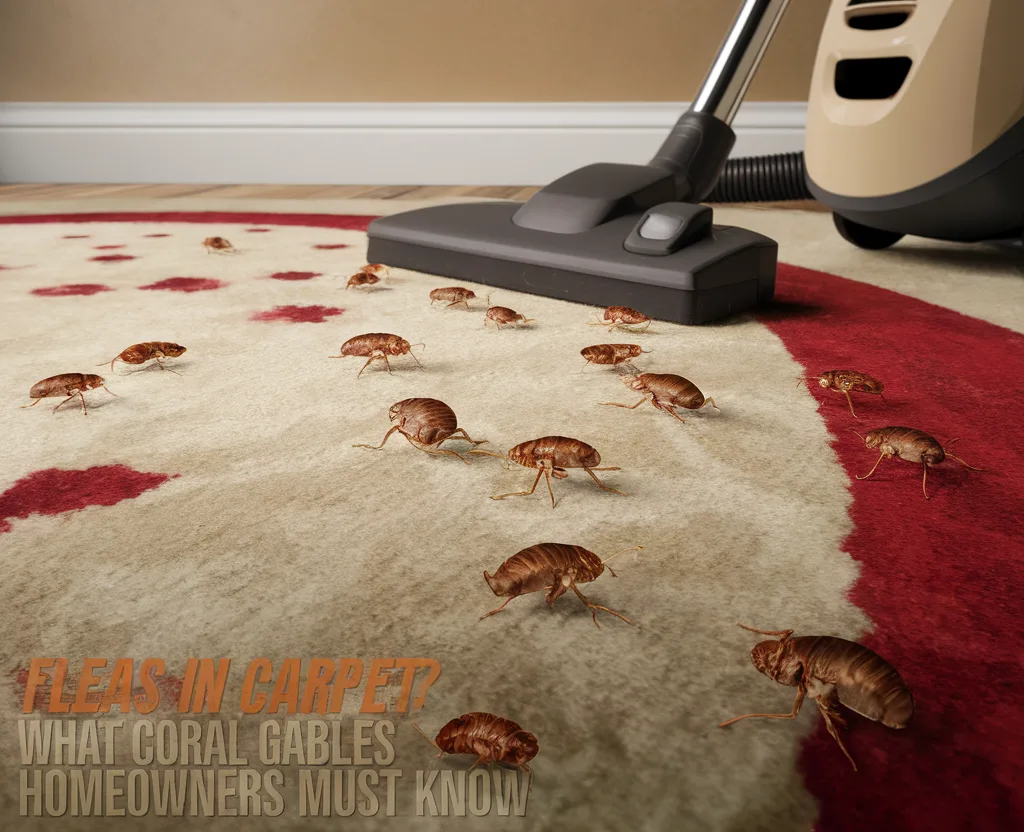
Picture this: You’ve just returned from a relaxing afternoon stroll through the Venetian Pool grounds with your dog, kicked off your shoes, and settled into your plush living room carpet. The sun is streaming through your windows, everything feels perfect. Then, minutes later, you notice tiny dark specks jumping across those cream-colored fibers. And then you feel it. That unmistakable itch creeping up your ankles.
That’s the moment when many Coral Gables homeowners realize they’re dealing with something they never expected in their beautiful Mediterranean-style home: a carpet flea infestation.
Here’s the thing about fleas in South Florida. They’re not just a minor annoyance that disappears with a quick vacuum. These tiny bloodsuckers multiply at rates that would shock you, and they’ve turned countless comfortable homes throughout Old Coral Gables, Riviera Section, and beyond into battlegrounds where families and pets wage constant war against invisible enemies living deep in their carpet fibers.
What many homeowners don’t realize is that the same things that make Coral Gables such an incredible place to live—our lush landscaping, walkable neighborhoods, pet-friendly culture, and year-round warm weather—create the perfect storm for flea populations to thrive. And once they establish themselves in your carpet, they’re notoriously difficult to eliminate without the right approach.
Why Your Coral Gables Home Is a Flea Magnet
Let me share something that might surprise you. Coral Gables isn’t just any Miami-Dade County community when it comes to flea problems. It’s actually one of the most vulnerable areas, and the reasons go far beyond just having pets.
Think about the neighborhoods like Granada and Cocoplum for a moment. These homes feature beautiful wall-to-wall carpeting that makes your bedroom feel like a luxury hotel. That plush comfort underfoot? It’s exactly what flea eggs, larvae, and pupae need to survive and multiply. They burrow deep into the carpet padding, finding refuge in places your vacuum cleaner can’t reach, protected from temperature extremes, safe from your efforts to eliminate them.
Then there’s our climate. While homeowners up north get a seasonal break when freezing temperatures kill off flea populations, we never get that relief. Our temperatures hover in the perfect flea-friendly range virtually every single day of the year. High humidity from afternoon thunderstorms? Check. Morning dew that maintains moisture levels? Check. Comfortable indoor temperatures from air conditioning? Check, check, check.
And let’s talk about those gorgeous tree-lined streets we all love. Those mature shade trees along Coral Way, the thick foundation plantings around homes, the manicured landscapes that give our city its distinctive character—they’re not just beautiful. They’re wildlife havens. Squirrels, raccoons, and other animals shelter in these green spaces, and they bring fleas with them. Those fleas eventually find their way into your yard, and from there, it’s just a short ride on your pet’s fur (or even your clothing) into your home.
The pet-friendly nature of Coral Gables adds another layer to the problem. Dog parks, outdoor cafés that welcome furry companions, the walkable streets perfect for evening strolls—all wonderful amenities that also mean your pets regularly encounter other animals. And their fleas. Even one flea hitching a ride after a walk through Venetian Pool Park can become hundreds within weeks, with the vast majority of that infestation living not on your pet, but in your carpet.
The Warning Signs You Might Be Missing
Here’s what happens to most families: They notice something’s off, but they don’t immediately connect the dots. Maybe you’re getting what feel like mosquito bites, even though you’ve been indoors all day. Your dog is scratching more than usual, but you figure it’s just the heat. You spot some dark specks on the carpet near where your cat likes to nap, but you assume it’s dirt they tracked in.
These dismissed moments? They’re your home trying to tell you a story about what’s happening beneath the surface.
What to Look For in Your Carpet
Walk over to your carpet right now, especially in the spots where your pets like to rest. Look closely at the fibers. See any tiny black specks that resemble ground pepper? That’s not dirt. That’s flea dirt, which is actually flea feces composed of digested blood. Want to be sure? Here’s a simple test that works every time: place some of those specks on a damp white paper towel. If they dissolve into reddish-brown stains, you’re looking at flea waste.
In heavier infestations, you’ll notice a salt-and-pepper appearance where dark flea dirt mixes with lighter-colored flea eggs. These eggs look like tiny grains of salt scattered throughout your carpet. If you’re seeing this pattern, the infestation has been growing for a while.
And if you actually spot tiny dark brown insects jumping across light-colored carpets when you walk through a room? That’s active adult flea activity. But here’s the unsettling part: those visible adult fleas represent only about 5% of your total flea population. The other 95% exists as eggs, larvae, and pupae hidden deep in your carpet where you can’t see them, developing into the next generation.
What Your Body Is Telling You
Your ankles and lower legs often serve as the first warning system. Flea bites on humans typically appear as small red bumps, often in clusters of two or three, concentrated in areas where your socks end or where clothing fits snugly against skin. They itch intensely, and unlike mosquito bites that fade relatively quickly, flea bites can remain itchy and inflamed for days.
Pets show even more obvious distress. That excessive scratching that’s been keeping you awake at night? The way your dog suddenly jumps up and bites at their hindquarters? Your cat’s restlessness during what used to be peaceful nap times? These aren’t just quirky behaviors. They’re signs of genuine discomfort from flea infestations.
Check your pet’s fur by parting it at the base of the tail and around the neck. These are prime feeding zones where you’re most likely to spot actual fleas or accumulations of flea dirt.
How Infestations Change Your Home Life
Something subtle happens when fleas take hold in your carpets. Your home stops feeling quite as comfortable. You find yourself avoiding certain rooms. Your children complain about itching after playtime on the floor. You hesitate to invite friends over, worried they’ll get bitten. You keep your pets off carpeted areas, which frustrates everyone involved.
One Pinecrest homeowner recently told our technicians at Dade Pest Solutions that she hadn’t sat on her living room floor to play with her toddler in over a month because she was so worried about flea bites. That’s not just a pest problem. That’s a quality-of-life problem.
The Hidden Dangers You Need to Understand
Let’s be honest about something important: flea infestations go way beyond itchy bites. The health implications can be serious, especially for the people and pets you care about most.
Fleas aren’t just annoying. They’re disease vectors. Their saliva contains proteins that trigger allergic reactions in sensitive individuals, leading to a condition called flea allergy dermatitis. This causes intense itching, inflammation, and often secondary skin infections from constant scratching. For children and pets with this allergy, even a few flea bites can cause misery lasting weeks.
Children playing on infested carpets face particular risks that keep parents up at night. Their closer proximity to floor surfaces, their tendency to sit directly on carpet during playtime, their developing immune systems—all of these factors increase their vulnerability. In severe infestations, young children and small pets can actually develop anemia from blood loss. It sounds extreme, but it happens more often than you’d think, especially with infants, elderly family members, and small animals.
There’s also the risk of disease transmission. While rare in South Florida, fleas can transmit murine typhus and serve as intermediate hosts for tapeworms. If a child accidentally ingests a flea while playing on carpet (easier than most parents realize), they can develop a tapeworm infection requiring medical treatment.
What Fleas Do to Your Pets
For those of us who consider our pets family members, watching them suffer from flea infestations is heartbreaking. Beyond the constant scratching and visible discomfort, heavy infestations create serious health problems:
- Flea allergy dermatitis ranks as the most common skin disease in dogs and cats, causing hair loss, scabs, and painful hot spots that require veterinary treatment
- Anemia from blood loss becomes particularly dangerous for puppies, kittens, and senior pets whose health is already compromised
- Tapeworm infections develop because fleas serve as intermediate hosts for these intestinal parasites
- Behavioral changes emerge, including anxiety, aggression, and sleep disruption from constant irritation
- Secondary infections develop when open wounds from scratching become entry points for bacteria
A Kendall veterinarian we work with regularly sees cases where pet owners waited too long to address carpet flea infestations, resulting in thousands of dollars in treatment costs that could have been avoided with earlier intervention.
The Property Impact Nobody Talks About
While fleas don’t damage home structures the way termites do, persistent carpet flea problems can significantly impact your property’s value and livability in ways that surprise homeowners. Many families dealing with chronic infestations eventually resort to removing and replacing all their carpeting—an expensive proposition in a multi-bedroom Coral Gables home where quality carpet replacement easily costs thousands of dollars.
Planning to sell your home? A flea infestation discovered during showings or inspections can derail negotiations faster than almost any other issue. The stigma lingers in potential buyers’ minds even after professional treatment eliminates the problem. Real estate agents throughout South Miami and surrounding areas know that pest issues, especially fleas, create emotional barriers that rational discussions about treatment can’t always overcome.
Why That DIY Approach Isn’t Working
Walk down the pest control aisle at any hardware store in Coral Gables, and you’ll find shelves packed with flea control products making bold promises. Easy application. Fast results. Money-back guarantees. And yet, most homeowners who try the DIY route find themselves right back in the store two weeks later, buying more products, spending more money, growing more frustrated.
There’s a reason for this pattern, and it’s not that you’re doing something wrong. It’s that flea biology makes DIY elimination extremely difficult, even when you follow product directions perfectly.
The Life Cycle Problem
Here’s what’s really happening in your carpet: Those adult fleas you can see jumping around? They represent maybe 5% of your total infestation. The real problem lives hidden in your carpet fibers and padding as eggs (50% of the population), larvae (35%), and pupae (10%).
Most over-the-counter products kill only adult fleas. They’re designed that way because adult fleas are easiest to target. But within days of your treatment, those untouched eggs hatch into larvae, larvae develop into pupae, and pupae emerge as new adult fleas. You haven’t failed. Your treatment simply never addressed the real problem.
The pupal stage presents the biggest challenge of all. Flea pupae develop inside protective cocoons that are virtually impervious to insecticides. These cocoons can remain dormant for months, waiting for the right signals—vibrations from foot traffic, carbon dioxide from breathing, warmth from body heat—to trigger emergence. This survival mechanism means fleas can seemingly reappear weeks after you believed you’d won the battle.
Equipment Makes the Difference
Even when homeowners select effective products, proper application proves difficult without professional equipment. Think about how deep fleas burrow into carpet padding. Standard consumer-grade sprayers simply can’t deliver product at the pressure and coverage density necessary to reach these hidden populations. Professional equipment used by companies like Dade Pest Solutions forces treatment deep into carpet fibers where developing fleas actually live, something that’s impossible with retail spray bottles.
There are also safety concerns that many homeowners don’t fully consider. Products strong enough to kill fleas can pose risks to children, pets, and family members with respiratory sensitivities. Without proper training in product selection and application, you can create health hazards while failing to effectively control the flea population.
The Whole-Home Requirement
Successfully eliminating carpet fleas requires treating your entire indoor environment, your outdoor spaces, and your pets simultaneously. Miss any component, and reinfestation happens almost immediately. This comprehensive approach requires coordinating multiple product types, application methods, and precise timing—a complex undertaking that overwhelms most homeowners and often results in incomplete treatment that wastes time and money.
What Professional Treatment Actually Looks Like
When homeowners throughout Coral Gables, Palmetto Bay, and surrounding communities call Dade Pest Solutions about carpet fleas, they often expect someone to show up, spray some chemicals, and leave. What they get instead is a comprehensive approach that addresses the real complexity of flea infestations.
The Inspection That Changes Everything
Professional flea treatment starts with a thorough inspection of your entire property. Our technicians examine all carpeted areas, identifying hot spots where fleas concentrate. We check under furniture that hasn’t been moved in months, inside closets where pets like to hide, along baseboards where larvae develop, and in areas homeowners typically overlook because they seem unimportant.
But the inspection doesn’t stop with carpets. We examine pet bedding, upholstered furniture, cracks in hardwood flooring adjacent to carpets, and outdoor areas where your pets spend time. This comprehensive assessment determines not just where fleas are living, but why they’re thriving in your specific environment. That information shapes a treatment strategy designed for your home’s unique situation rather than a one-size-fits-all approach.
Treatment That Addresses the Full Life Cycle
Professional carpet flea treatment involves multiple components working together. We use professional-grade products containing both adulticides that kill adult fleas and insect growth regulators that prevent immature stages from developing into adults. These products get applied deep into carpet fibers and padding using specialized equipment that ensures thorough coverage at the penetration depth necessary for effectiveness.
Treatment extends beyond carpets to baseboards, cracks, crevices, and other areas where flea larvae develop, creating a comprehensive barrier against reinfestation. Because fleas often originate outdoors, we treat yard spaces where pets rest, shaded areas under vegetation, and pathways between outdoor spaces and entry points.
We also coordinate with your veterinarian’s flea control protocol for your pets. All infestation components must be addressed simultaneously, or you’ll just keep cycling through partial control and reinfestation.
The Follow-Up That Ensures Success
Because of the flea life cycle, professional treatment typically requires follow-up visits. Initial treatment eliminates adult fleas and prevents eggs from developing, but those pupae in cocoons need time to emerge. Follow-up treatments target newly emerged adults before they reproduce, breaking the infestation cycle completely.
Throughout the process, our technicians provide monitoring and education about maintaining flea-free carpets after elimination. This ongoing support ensures long-term success rather than temporary relief that leaves you right back where you started.
Keeping Fleas Out After You’ve Won the Battle
Once you’ve eliminated carpet fleas from your home, the question becomes: How do you keep them from coming back? In Coral Gables’ climate, prevention isn’t optional. It’s essential.
Protecting Your Pets Year-Round
Your first line of defense starts with your pets. Unlike homeowners in northern climates who can use seasonal flea products, South Florida’s weather requires year-round prevention for all pets. Work with your veterinarian to select prescription-strength topical treatments, oral medications, or flea collars appropriate for your pet’s specific needs.
Weekly grooming sessions provide opportunities to check for fleas before populations establish in your carpet. Use a flea comb over white paper to detect fleas and flea dirt early, when they’re easiest to address. And when visiting dog parks or walking in heavily wooded areas, stay vigilant about your pet’s exposure to other animals and wildlife that may carry fleas.
Carpet Maintenance That Makes a Difference
Consistent carpet care creates an environment where fleas struggle to survive. Vacuum carpeted areas at least twice weekly, focusing on areas where pets rest and along baseboards. Vacuuming removes flea eggs, larvae, and the organic debris they feed on, while also stimulating pupae to emerge from their protective cocoons.
Here’s a critical detail many homeowners miss: After vacuuming, immediately remove the vacuum bag or empty the canister into a sealed plastic bag and dispose of it outside your home. Flea eggs and larvae can continue developing in vacuum bags, turning your vacuum cleaner into a mobile flea incubator.
Periodic professional steam cleaning kills flea eggs and larvae through heat exposure while removing organic debris. And keep carpeted areas free from stored items, clothing piles, and excess furniture that creates undisturbed spaces where fleas can develop without interruption.
Managing Your Outdoor Environment
Controlling fleas means managing the outdoor spaces that serve as infestation sources. Keep grass trimmed, remove leaf litter, and thin dense vegetation where wildlife harbors and fleas thrive. Discourage wildlife from sheltering near your home by securing garbage, removing food sources, and eliminating access to spaces where animals might nest.
If your pets have favorite outdoor resting spots, consider treating these areas with pet-safe outdoor flea control products. Providing elevated pet beds that don’t contact soil can also help reduce flea exposure. And seal gaps around doors, windows, and utility penetrations that allow fleas from outdoor areas to enter your home directly.
Understanding Realistic Timelines
One of the most common sources of frustration for homeowners dealing with carpet fleas involves expectations about how quickly the problem resolves. Even with professional treatment, eliminating carpet fleas typically takes 4-8 weeks for complete resolution.
This extended timeline isn’t a reflection of treatment failure. It’s simply flea biology at work. After initial treatment, you’ll notice immediate reduction in adult flea activity and biting. But expect to see some continuing flea activity for several weeks as pre-existing pupae emerge. This is normal and expected. Each emerging flea gets killed by residual treatment before reproducing, progressively reducing the population to zero.
Several factors influence how quickly your home becomes completely flea-free. Heavy infestations require more time than early-stage problems. Homes with extensive carpeting, multiple pets, or clutter that impedes thorough treatment may need longer elimination timelines. If pets aren’t properly treated concurrently, they continuously reintroduce fleas into treated carpets. And continued exposure to untreated outdoor areas or wildlife can introduce new fleas even as interior populations decline.
The key is maintaining treatment protocols and following professional recommendations throughout the full elimination period, even when you’re not seeing as many fleas. Stopping treatment prematurely is the most common reason for reinfestation.
The Climate Reality We All Face
Here’s something that Coral Gables homeowners need to understand: Unlike people living in northern climates who get seasonal breaks from flea pressure, we face year-round flea activity. This isn’t going to change. It’s the price we pay for our beautiful weather and outdoor lifestyle.
Fleas thrive in temperatures between 65-80°F with humidity levels above 70%. That describes South Florida weather virtually every single day of the year. Even during our cooler months from December through February, temperatures rarely drop low enough to kill fleas or stop their development.
Constant moisture from afternoon thunderstorms in summer and morning dew throughout the year maintains the humidity fleas need for egg and larval survival. Your air-conditioned home provides even more stable conditions for flea populations than outdoor environments experience.
This climate reality means we need to adopt a prevention mindset rather than responding to infestations reactively. Year-round pet preventives, consistent carpet maintenance, and periodic professional preventive treatments provide the most cost-effective and comfortable approach to flea management in our area.
Protecting Your Home and Family
Your Coral Gables home represents a significant investment and the foundation of your family’s daily life. It deserves protection from the damage and discomfort that carpet fleas cause. Whether you’re currently dealing with an active infestation or seeking to prevent one from developing, understanding the unique challenges our local climate and environment present helps you make informed decisions.
Carpet fleas aren’t a problem you can ignore, hoping they’ll resolve on their own. Without intervention, infestations worsen exponentially, spreading from isolated areas throughout your home, affecting every family member and pet. The itching, the stress, the health concerns—they all escalate alongside the growing population of these persistent parasites.
Professional pest control offers expertise in addressing the complete flea life cycle, reaching treatment areas DIY approaches can’t access, and providing the follow-through that ensures complete elimination rather than temporary relief. For homeowners throughout Coral Gables, South Miami, Kendall, and surrounding Miami-Dade communities struggling with carpet fleas, professional intervention represents not an expense but an investment in your family’s comfort, your pets’ health, and your home’s livability.
At Dade Pest Solutions, we’ve built our reputation on understanding the unique challenges that South Florida homeowners face with carpet fleas. Our technicians have seen it all—from early-stage infestations caught just in time to severe cases where homeowners tried everything else before finally calling us. We’ve developed treatment protocols specifically designed for our climate, our housing types, and the specific flea species that thrive in Miami-Dade County.
We serve Coral Gables and surrounding communities including South Miami, Pinecrest, Palmetto Bay, Kendall, Cutler Bay, Homestead, and throughout Miami-Dade County with comprehensive flea control services that address current infestations and prevent future problems. Our approach combines professional-grade products, specialized equipment, comprehensive treatment strategies, and ongoing support that ensures your home becomes—and stays—flea-free.
If you’re waking up with bites, watching your pets suffer, or avoiding your own carpeted rooms because of flea activity, you don’t have to live this way. Contact Dade Pest Solutions today for a thorough inspection and customized treatment plan. Your Coral Gables home deserves the comfort and protection that comes from working with pest control professionals who know fleas inside and out, and who know exactly how to eliminate them for good.
Because at the end of the day, your home should be a place where you feel comfortable kicking off your shoes, sitting on the floor with your children, and letting your pets relax on their favorite carpet spots without worry. That’s not too much to ask. And with the right professional help, it’s entirely achievable—even in South Florida’s flea-friendly climate.

17 Years of Pest Control Experience Founder and Owner of Dade Pest Solutions Proud Resident of South Florida
Shaun Judy, a dedicated South Florida native, is the founder and driving force behind Dade Pest Solutions. With over 17 years of hands-on experience in the pest control industry, Shaun has built a reputation for reliability, results, and real local knowledge. His journey began with a deep commitment to protecting homes from pests using proven methods and innovative solutions. Raised with a strong work ethic and a passion for service, Shaun treats every property as if it were his own—delivering expert care with a personal touch.
