
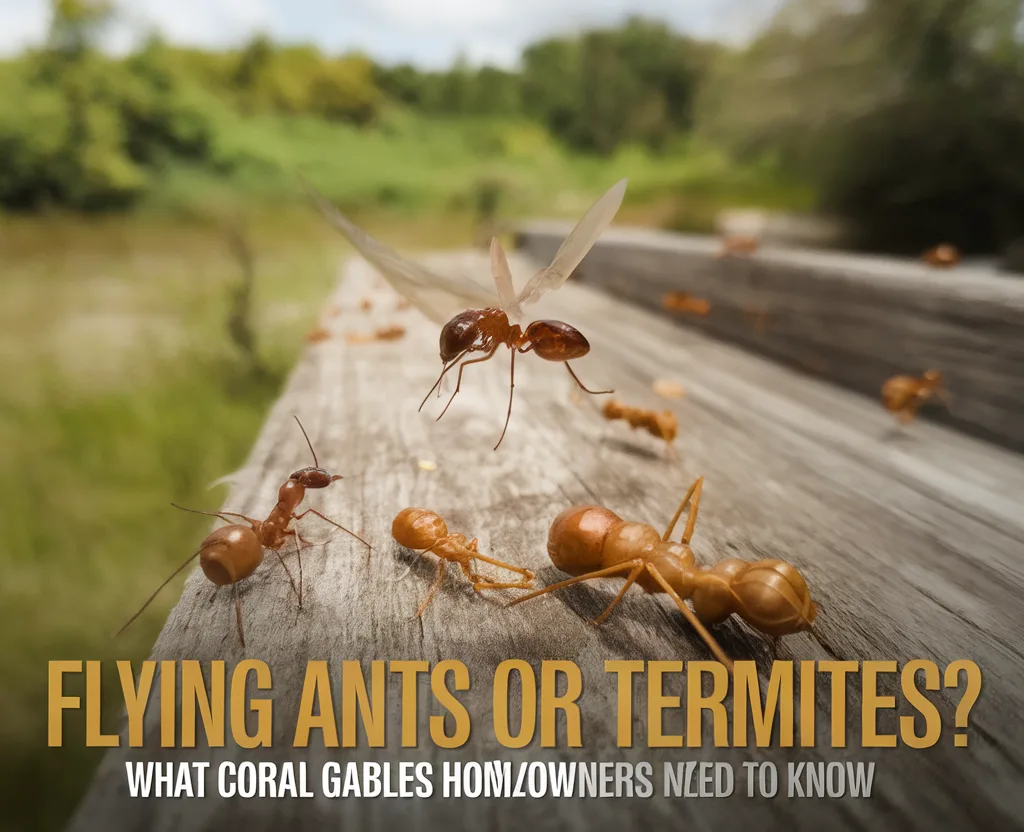
Picture this: You’re settling into your favorite chair with your morning coffee, enjoying the soft light filtering through your Coral Gables windows, when something catches your eye. A small cluster of winged insects is gathering near the window frame. Your stomach tightens just a bit. Are those flying ants? Or could they be termites, silently compromising the very bones of your home?
It’s a moment that stops you cold. And if you’re like most homeowners in our beautiful community, you’re now staring at those insects with a mixture of curiosity and dread, wondering what you’re really dealing with.
Here’s the thing: that tiny swarm you’ve spotted isn’t just a nuisance to swat away. It’s your home trying to tell you something important. Whether it’s a minor inconvenience or the early warning sign of something much more serious depends entirely on identifying exactly what’s buzzing around your property. And in Coral Gables, where the architecture is as distinctive as the landscaping is lush, getting this identification right matters more than you might think.
Why Your Coral Gables Home Faces Unique Pest Pressures
Let’s talk about what makes our community special. The tree-lined streets, the Mediterranean Revival homes with their romantic archways and terracotta roofs, the tropical gardens that make every property feel like a private oasis. It’s gorgeous, right? That’s why we chose to live here.
But those same features that drew us to Coral Gables also create an ideal environment for winged pests. The year-round warmth means there’s no winter freeze to knock back insect populations. Our humidity, especially during those steamy summer months when it feels like you’re walking through bathwater just getting to your car, provides exactly the moisture termites need to thrive.
And those afternoon thunderstorms we get used to? The ones that roll in like clockwork during summer, darkening the sky and sending everyone scrambling to bring in the patio cushions? Those rainstorms trigger something called nuptial flights. It’s when winged ants and termites leave their colonies en masse to mate and start new colonies. So if you’ve noticed sudden swarms appearing right after a storm, now you know why.
I’ve talked with homeowners throughout Coral Gables, Pinecrest, and South Miami who’ve experienced this. One homeowner in a historic 1920s home near the Biltmore told me she thought the swarm appearing after a summer rain was just a natural occurrence, nothing to worry about. By the time she discovered they were termites, not flying ants, the colony had already done thousands of dollars in damage to original wood trim that couldn’t be replaced.
The Architecture We Love Can Work Against Us
Here’s something many newer residents don’t realize: those stunning older homes that give Coral Gables so much of its character also come with vulnerabilities. Wood framing and trim from the 1920s and 1930s, while often beautifully crafted, has had decades to develop tiny cracks, absorb moisture during hurricane seasons, and create perfect entry points for pests.
The stucco exteriors we see throughout the neighborhood can develop hairline fractures over time. And that mature landscaping, those massive ficus trees and lush tropical plants that create such wonderful shade and privacy? When they’re planted too close to your foundation, they trap moisture against your home and create highways for pests to travel from soil to structure.
Even newer construction in areas like Riviera or The Crossings faces challenges. Properties near our waterways and canals deal with elevated moisture levels. That beautiful tree canopy that keeps your yard cool also keeps it damp, preventing moisture from evaporating quickly after our frequent rains.
Flying Ants and Termites: Spotting the Difference
So you’re standing there looking at winged insects. What are you actually seeing? Let me walk you through the detective work, because accurate identification is your first line of defense.
Think of flying ants as having an hourglass figure. They have three distinct body segments with a narrow, pinched waist between the thorax and abdomen. Termites, on the other hand, have a broad, straight body with no obvious waist. Their body looks more like a uniform tube from head to tail.
Now look at the antennae if you can get close enough. Ant antennae are bent or elbowed, making a clear angle in the middle. Termite antennae are straight and beaded, looking like tiny strings of pearls.
But here’s the easiest way to tell them apart: the wings. Flying ants have two pairs of wings, but the front pair is noticeably larger than the back pair. Termite wings are equal in length, all four wings the same size and shape. Plus, termite wings are disproportionately long compared to their body, often extending well beyond the abdomen.
What about color? In Miami-Dade County, including throughout Coral Gables, Kendall, and Homestead, you’re most likely to encounter subterranean termites, which range from cream to dark brown or black. Flying ants in our area commonly include carpenter ants that are black or red-black, though various species come in shades from light brown to black.
What Their Behavior Tells You
Beyond physical appearance, watching how these insects behave reveals important clues. Termite swarmers shed their wings almost immediately after landing, often within minutes. If you’re finding piles of discarded wings near windowsills, door frames, or scattered on your patio, that’s a strong indicator of termites. Flying ants keep their wings attached much longer.
Termites typically swarm during daylight hours, particularly in the morning, and they’re strongly attracted to light sources. If you notice swarms near lamps or bright windows, termites are more likely the culprit. Flying ants can swarm at various times and aren’t as dramatically drawn to light.
Pay attention to where they’re appearing too. In Coral Gables homes, termite swarmers often emerge from cracks in walls, around baseboards, or near foundation areas. They’re coming from inside the structure itself. Flying ants are more likely to be seen coming from outdoor nests, though carpenter ants may emerge from damaged wood inside your home.
The Silent Damage You Can’t See
Here’s what keeps me up at night when I think about termite infestations: swarmers are just the tip of the iceberg. They’re the visible symptom of a much larger problem happening where you can’t see it.
A homeowner in Palmetto Bay once called us after noticing what she thought was water damage on her baseboards. The paint looked slightly bubbled, and when she pressed on the wood, it felt soft. She assumed she had a plumbing leak somewhere. When our technician arrived, he found something very different: an active termite infestation that had been quietly working its way through the interior walls for months, possibly years.
Termites eat wood from the inside out, so damage often isn’t visible on the surface until it’s extensive. You might tap on wood and hear that distinctive hollow sound. Baseboards or window frames might feel soft or crumble when pressed. Sometimes paint or wallpaper appears bubbled or uneven because termites create moisture behind surfaces as they work.
Look for mud tubes on your foundation, especially in shaded areas near your air conditioning units or garden spaces. These pencil-width tubes are how subterranean termites travel between soil and food sources. They’re essentially protected highways that allow termites to move safely while maintaining the humidity they need to survive.
And if you’re finding small piles of pellets that look like sawdust or coffee grounds near wooden furniture, window frames, or walls, that’s frass from drywood termites. While subterranean termites are more common in our area, drywood termites are definitely present in Coral Gables and push out these telltale pellets as they hollow out wood.
When Flying Ants Signal Their Own Problems
Now, just because you’ve identified flying ants instead of termites doesn’t mean you’re entirely in the clear. Certain ant species bring their own concerns.
Carpenter ants are common throughout Miami-Dade County, and while they don’t eat wood like termites do, they excavate it to create nesting galleries. I’ve seen carpenter ant damage in homes from Country Walk to Little Gables. These large black or red-black ants tunnel through wood, and over time, that tunneling can compromise structural integrity.
Signs of carpenter ant activity include piles of sawdust-like material below wooden areas, but this material is coarser than termite pellets and may contain insect body parts. You might hear faint rustling sounds inside walls, particularly at night when these ants are most active. And of course, you’ll see the winged reproductives emerging from wall voids or ceiling areas during their mating season.
Even if you’re dealing with ant species that don’t damage structures, their presence inside often indicates gaps or cracks in your home’s exterior that need sealing, moisture problems that are attracting them, or nearby outdoor colonies that may eventually pose bigger problems.
The Real Cost of Getting It Wrong
Let’s talk numbers for a moment, because the financial stakes here are significant. Termites cause over five billion dollars in property damage annually across the United States. Florida consistently ranks among the states with the highest termite activity. And in Coral Gables specifically, where property values frequently exceed a million dollars, the financial exposure is especially serious.
A mature termite colony can contain hundreds of thousands of individual termites. Think about that for a second. Hundreds of thousands of tiny insects, each one methodically consuming the wood that holds up your home. A mature colony can eat roughly one foot of 2×4 wood in six months. When you consider that colonies often go undetected for years, the potential damage becomes staggering.
The average cost of termite damage repairs in South Florida ranges from three thousand dollars for minor damage to twenty thousand dollars or more for extensive structural repairs. In historic Coral Gables homes with custom millwork and period-appropriate materials, costs can climb even higher because you’re not just replacing generic lumber. You’re trying to match architectural details that may be nearly a century old.
And here’s the kicker: homeowners insurance typically doesn’t cover termite damage. This comes entirely out of your pocket.
Perhaps equally problematic is treating a termite problem as though it’s merely flying ants. Over-the-counter ant sprays and baits do absolutely nothing to address termite colonies. Meanwhile, the infestation continues growing and causing damage. Every month of delayed proper treatment allows the colony to expand, workers to consume more structural wood, and damage to spread to additional areas of your home.
Protecting Your Home the Right Way
So what can you actually do about this? Let’s start with prevention strategies that make sense for our specific climate and conditions.
Moisture management is absolutely critical in our humid Coral Gables environment. Make sure your gutters and downspouts are directing water at least three to four feet away from your foundation. Fix any plumbing leaks promptly, even those slow drips under sinks that seem too minor to worry about. Address air conditioning condensation issues, because AC units in our area run almost year-round, producing substantial moisture.
Take a walk around your property and look at your landscaping with fresh eyes. Are branches touching your house? Is mulch piled up against your foundation? Is your irrigation system spraying directly on your siding? These might seem like small things, but they create the exact conditions that attract termites and ants.
For historic homes, pay special attention to maintaining original wood elements. Inspect windows, doors, and decorative trim regularly. Address any stucco cracks promptly to prevent moisture intrusion. These beautiful old homes require ongoing care to stay ahead of problems.
Seal cracks and gaps around utility penetrations where pipes, wires, and cables enter your home. Install or maintain door sweeps on exterior doors. Repair damaged window screens. Address any areas where wood makes direct contact with soil, because that creates a direct highway for termites to access your home.
When It’s Time to Call in the Professionals
Here’s the truth: some situations require professional expertise. If you observe any swarm of winged insects emerging from inside your home, if you’re finding multiple discarded wings near windows or doors, if you see visible mud tubes on your foundation or walls, or if wood sounds hollow or shows signs of damage, it’s time to call in experienced professionals who know what they’re looking at.
Throughout neighborhoods like Cutler Bay, Homestead Base, and Naranja, homeowners have learned that DIY approaches have their limits. You can manage some pest issues on your own, but termites and carpenter ants require specialized knowledge and treatment methods.
A licensed pest control professional can quickly differentiate between flying ants and termites. More importantly, they can assess the extent of any infestation, identify the specific species involved, locate colonies and entry points you might miss, evaluate conducive conditions around your property, and recommend targeted treatment approaches that actually work.
For Coral Gables homeowners, working with a local pest control company offers the additional advantage of experience with our specific construction types, common local species, and climate conditions. Someone who regularly works in Princeton and Redland understands the difference between treating a 1920s Mediterranean Revival home and a 1990s concrete block construction in Richmond West.
What Professional Treatment Actually Involves
If you’ve never worked with a pest control company before, you might be wondering what the process actually looks like. It starts with a comprehensive inspection that examines your home’s foundation, exterior walls, windows, doors, and roof line for signs of activity and conducive conditions. The technician will check interior spaces including any crawl spaces, attics, and living areas for evidence of infestation.
This inspection determines whether you’re dealing with termites or ants, identifies the specific species, locates active colonies, and evaluates the extent of any infestation. Only after gathering all that information can an effective treatment plan be developed.
For termites, treatment options might include liquid termiticides that create a protective barrier in the soil around your foundation. When termites contact or ingest the treated soil, the colony is affected. Modern termiticides are highly effective and can provide protection for many years.
Termite baiting systems involve strategically placed stations containing cellulose material laced with slow-acting termiticides. Termites consume the bait and share it throughout the colony, eventually eliminating the entire colony including the queen.
For drywood termite infestations, professionals may treat specific affected areas with products that eliminate localized colonies. In cases of extensive drywood termite infestation, whole-structure fumigation may be recommended, involving tenting the entire home and introducing a gas that penetrates all wood.
Carpenter ant and other ant treatments typically involve identifying and treating the primary colony, eliminating satellite colonies that may be inside structures, applying targeted treatments to areas where ants enter and travel, and implementing perimeter treatments to prevent future invasions.
The Peace of Mind That Comes with Ongoing Protection
Many homeowners throughout Coral Gables and surrounding communities have discovered the value of ongoing professional protection rather than waiting for problems to develop. Regular pest control services that include termite monitoring and ant prevention provide regular inspections to catch problems early, preventive treatments that stop infestations before they start, monitoring systems that alert professionals to termite activity, and priority service if issues do develop.
For properties in areas like Silver Palm and Glenvar Heights, where home values and the cost of extensive repairs are both high, the relatively modest investment in preventive pest control provides substantial peace of mind and financial protection.
Your Next Steps
So you’ve spotted winged insects around your property. You’ve read through the identification tips and warning signs. What now?
First, don’t panic. Spotting a swarm doesn’t automatically mean your home is falling down around you. But don’t ignore it either. Take a few minutes to observe the insects if they’re still visible. Try to note the physical characteristics we discussed. Check around your property for other warning signs like discarded wings, mud tubes, or wood damage.
If you’re dealing with just a few flying ants that clearly came from outside, it might be a minor issue you can address with improved sealing and moisture control. But if you’re seeing swarms emerging from inside your home, finding piles of wings, or noticing any of the structural warning signs we’ve discussed, professional evaluation isn’t just helpful, it’s essential.
Remember that what appears to be a small swarm or isolated incident may indicate a much larger hidden colony. Termite colonies can number in the hundreds of thousands, working silently within your walls, floors, and structural framing. By the time damage becomes obvious, substantial destruction has often already occurred.
Why Local Expertise Matters
At Dade Pest Solutions, we’ve been protecting homes throughout Miami-Dade County for years. We understand the unique challenges that homeowners in Coral Gables, Pinecrest, Palmetto Bay, and surrounding communities face with termites and ants. We’re thoroughly familiar with both the architectural characteristics of our area and the pest pressures specific to our subtropical climate.
We’ve treated historic Mediterranean Revival homes where preserving original materials was just as important as eliminating the infestation. We’ve protected newer construction in developments throughout Kendall and The Crossings. We’ve worked in properties near the water in areas like Cutler Bay and properties inland in neighborhoods like Country Walk and Richmond West. We understand how different locations, construction types, and landscaping situations create different challenges.
When you call us, you’re not getting a one-size-fits-all approach or someone reading from a corporate script. You’re getting experienced local professionals who know your neighborhood, understand your concerns, and can provide honest guidance about what you’re actually dealing with and what it will take to address it.
We provide comprehensive inspections that tell you exactly what you’re facing. We’ll identify whether you have flying ants or termites, what species is involved, where colonies are located, and what conducive conditions around your property might be contributing to the problem. Then we’ll recommend a treatment plan tailored specifically to your situation, explaining your options clearly so you can make informed decisions about protecting your home.
Common Questions Coral Gables Homeowners Ask Us
How do I know if those wings I found are from termites or flying ants? Termite wings are all the same size and are typically found in piles because termites shed them almost immediately after swarming. Ant wings have different sizes (front wings larger than back wings) and usually aren’t found in such concentrated piles. If you’re finding substantial piles of discarded wings near windows or doors, termites are more likely.
Can termites and flying ants be active at the same time? Absolutely. Both respond to similar weather triggers, particularly the combination of humidity and rain that we get during our summer months. This is why accurate identification is so important. You could be dealing with one species or both.
Are termites more common in older Coral Gables homes? Older homes do face some increased vulnerability due to decades of potential moisture exposure and the natural aging of materials. However, termites can and do infest newer construction as well. The key factors are available food sources (wood), moisture, and access points, all of which can be present regardless of a home’s age.
How often should I have my home inspected for termites? In our climate, annual termite inspections are recommended as part of routine home maintenance. If you’ve had previous termite activity, if your property has conducive conditions like significant moisture issues or extensive landscaping near the structure, or if you live in an area with known termite pressure, more frequent inspections might make sense.
Is termite damage really not covered by homeowners insurance? Typically, no. Standard homeowners insurance policies exclude damage caused by insects, including termites. This is considered preventable maintenance rather than a sudden, unexpected event. This makes prevention and early detection even more critical from a financial standpoint.
What’s the difference between subterranean and drywood termites? Subterranean termites, the most common type in our area, live in soil and build mud tubes to access above-ground food sources. They require contact with soil and moisture. Drywood termites live entirely within the wood they consume and don’t require soil contact. They’re somewhat less common but definitely present in Coral Gables. Treatment approaches differ significantly between the two.
Can I treat a termite problem myself? While there are some DIY termite treatment products available, professional treatment is strongly recommended. Termites often have multiple colonies, access points that aren’t obvious, and damage that extends further than visible signs suggest. Incomplete treatment allows the problem to continue, ultimately costing more in both treatment and damage repair. Professional treatment also typically comes with warranties or guarantees that DIY approaches don’t provide.
How long does termite treatment take? This depends on the treatment method and the extent of infestation. Liquid barrier treatments typically take a few hours for an average-sized home. Baiting systems involve initial installation followed by monitoring visits over several months. Fumigation requires the home to be tented for two to three days. Your pest control professional can give you a specific timeline based on your situation.
Will I need to leave my home during treatment? For most liquid treatments and baiting system installations, you don’t need to leave. For fumigation, you’ll need to vacate the property for two to three days. Your pest control company will provide detailed preparation instructions for any treatment requiring you to leave.
What about my pets and plants during treatment? Pets typically need to be kept away from treatment areas until products have dried, which usually takes a few hours. Plants near the foundation may need protection during some liquid treatments. For fumigation, pets must leave with you, and potted plants usually need to be removed from the property. Your pest control professional will provide specific guidance based on the treatment approach.
Your Coral Gables Home Deserves Protection
Your home represents more than just a financial investment. It’s where you build memories, where your family gathers, where you find refuge from the world. Whether you own a historic treasure in one of Coral Gables’ most sought-after neighborhoods or a newer home in a developing area of Miami-Dade County, protecting that investment and that sanctuary matters.
The combination of our year-round warmth, high humidity, and lush tropical environment creates conditions where termites and ants thrive. Understanding the difference between flying ants and termites, recognizing warning signs of activity, and taking appropriate action aren’t just helpful practices. They’re essential elements of responsible homeownership in our area.
If you’re dealing with winged insects, if you’ve noticed any of the warning signs we’ve discussed, or if you simply want the peace of mind that comes from knowing your home has been professionally evaluated, we’re here to help. Contact Dade Pest Solutions today for a comprehensive inspection. We serve homeowners throughout Coral Gables, South Miami, Pinecrest, Palmetto Bay, Cutler Bay, Kendall, Homestead, and surrounding Miami-Dade communities.
We’ll come to your property, conduct a thorough evaluation, provide honest answers about what we find, and if treatment is needed, explain your options clearly so you can make the best decision for your home and your budget. Because your Coral Gables home is one of your most valuable assets, and protecting it should never feel like a gamble. It should feel like partnering with people who understand what’s at stake and have the expertise to help you protect it.
Give us a call or reach out through our website. Let’s make sure those winged insects you spotted are nothing more than a minor inconvenience rather than the beginning of a costly problem. Your home deserves that level of care, and you deserve the peace of mind that comes from knowing it’s protected.

17 Years of Pest Control Experience Founder and Owner of Dade Pest Solutions Proud Resident of South Florida
Shaun Judy, a dedicated South Florida native, is the founder and driving force behind Dade Pest Solutions. With over 17 years of hands-on experience in the pest control industry, Shaun has built a reputation for reliability, results, and real local knowledge. His journey began with a deep commitment to protecting homes from pests using proven methods and innovative solutions. Raised with a strong work ethic and a passion for service, Shaun treats every property as if it were his own—delivering expert care with a personal touch.