
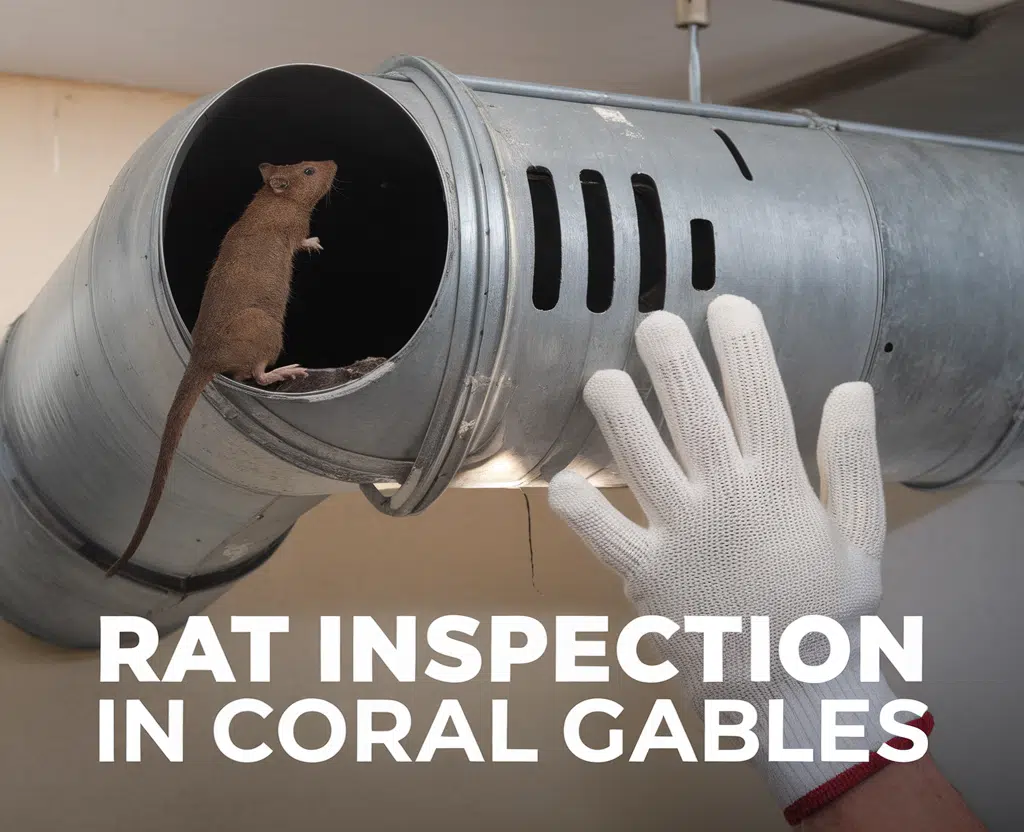
Picture this: It’s a quiet Tuesday evening in your beautiful Coral Gables home. You’ve just settled into your favorite chair with a book when you hear it. A scratching sound. Faint at first, then unmistakable. It’s coming from inside the wall.
Your stomach drops. You set down your book and listen more carefully. There it is again. A scurrying sound in the attic, perhaps? Or maybe behind the baseboards? That peaceful moment you were savoring suddenly feels very different. Because you know what that sound likely means.
You’re not alone in this experience. Homeowners throughout Coral Gables, Pinecrest, South Miami, and across Miami-Dade County face this exact scenario more often than you might think. And here’s what makes it particularly frustrating: that rat didn’t just appear in your walls by magic. It found a way in. Maybe through a gap no wider than your thumb. Maybe through a crack you’ve walked past a hundred times without noticing.
The thing is, our gorgeous Coral Gables homes, with their Mediterranean charm and lush tropical landscaping, are absolutely beautiful to us. But to a rat? They’re an open invitation. Those clay tile roofs we love so much, the mature banyan trees providing perfect shade, the ornate architectural details that make our neighborhood so distinctive? Rats see them as highways, hiding spots, and doorways.
Understanding where and how rats enter your home isn’t just about solving a current problem. It’s about protecting your family’s health, preserving your property’s value, and reclaiming that peace of mind you deserve when you’re relaxing in your own space.
Why Your Coral Gables Home Is Speaking Rat Language
Let me share something that surprises most homeowners I talk to: a rat doesn’t need a rat-sized hole to get into your house. A gap the width of a quarter is enough for a mouse. A space about as big as a half-dollar? That’ll do for a full-grown Norway rat. And roof rats, the acrobatic climbers we deal with constantly in Miami-Dade County, can squeeze through openings even smaller.
Walk outside right now and look at your home through fresh eyes. See that beautiful ficus hedge touching your exterior wall? Those overhanging oak branches creating such lovely dappled shade on your roof? That charming gap where your decorative corbels meet the roofline? Every single one of those features is telling rats, “Welcome home.”
Here’s what makes our area uniquely challenging. Many Coral Gables homes were built in the 1920s through 1940s, during that golden age of Mediterranean Revival architecture. The craftsmanship is stunning. The character is irreplaceable. But those homes were built in an era before anyone thought about rodent-proofing as part of the construction process. Clay tiles create natural gaps. Ornamental vents were designed for beauty, not security. Foundation work has settled over decades, creating cracks that start small and grow larger each year.
Even newer homes in neighborhoods like Riviera or Glenvar Heights aren’t immune. Our subtropical climate is working against us year-round. During the wet season from May through October, heavy rains flood the burrows where Norway rats typically nest underground. Where do they go when their homes flood? Up. Into your attic. Into your walls. Into the dry, protected spaces your home provides.
And when we get those occasional dry spells? Rats start hunting aggressively for water sources. That tiny drip under your bathroom sink you’ve been meaning to fix? That’s a rat magnet. The condensation from your AC unit creating a small puddle near your foundation? Same thing.
The challenge we face in Coral Gables isn’t just that rats want to get in. It’s that our environment gives them so many ways to do it, and so many reasons to try.
The Entry Points Hiding in Plain Sight
I’ve inspected hundreds of homes throughout Miami-Dade County, from historic properties in Coral Gables to newer construction in Country Walk and The Crossings. Want to know what I’ve learned? The entry points that cause the biggest problems are rarely the ones homeowners notice first.
Take roof-soffit intersections, for example. That’s the spot where your roofline meets the horizontal board (the soffit) under your roof’s overhang. Most people never look up there. Why would you? But that junction is one of the most common entry points I find during inspections. A small gap there, maybe created when your fascia board pulled away slightly over the years, gives rats direct access to your attic space.
Your beautiful clay tile roof? Each tile overlaps the next, creating a weatherproof surface that’s stood the test of time. But at the edges, where tiles meet the fascia, there are often spaces. Roof rats, with their incredible climbing ability, can access those tiles from overhanging branches and squeeze right underneath them. Once they’re on your roof deck, they’re looking for the next way in.
Here’s another spot that catches homeowners by surprise: weep holes. These are those small openings in brick veneer or stucco, usually near the bottom of exterior walls. They’re there by design, allowing moisture to drain out. But if they’re not properly screened, they’re perfectly sized for rat entry. I’ve found rats using weep holes to access wall cavities in homes from Palmetto Bay to Kendall.
Your garage door probably seems secure enough. But flip on a flashlight at night and look at the seal where the door meets the ground. See any light coming through? If light can get through, so can a rat. That rubber seal deteriorates quickly in our heat and humidity. The gaps at the sides where your garage door doesn’t quite seal against the frame? Same problem.
Let me tell you about AC line penetrations, because this is something I see constantly. When your air conditioning was installed, someone drilled holes through your exterior wall to run the refrigerant lines and electrical connections. Those holes are almost always larger than they need to be. And the sealing around them? Often it’s just expanding foam that rats can gnaw right through. That’s a direct pathway into your wall cavities.
I remember inspecting a gorgeous home in Little Gables last year. The homeowner was baffled. She kept finding droppings in her kitchen but couldn’t figure out how rats were getting in. Her home was well-maintained, recently painted, landscaping trimmed back properly. Then I checked behind her dryer. The vent going to the exterior had a flap that was supposed to close when the dryer wasn’t running. But the spring mechanism had failed, leaving it hanging open. Rats were coming and going like they owned the place.
What Your Home Is Trying to Tell You
Sometimes the signs are obvious. You see an actual rat. That’s pretty definitive. But more often, rats leave calling cards that are easy to miss if you don’t know what to look for.
Those small, dark droppings you noticed when you were pulling out the pots and pans last week? Rat droppings look like dark grains of rice, usually about half an inch long. Finding them means rats are actively traveling through that area. And here’s the thing about rat behavior: they’re creatures of habit. They follow the same pathways repeatedly, which is why you’ll often see those droppings concentrated in the same spots.
Have you noticed dark smudge marks along your baseboards, especially in corners or along walls? That’s from the oils in rat fur. As they squeeze along walls and through tight spaces, they leave these greasy marks behind. The more established the pathway, the darker the smudge.
Maybe you’ve found small holes gnawed through your baseboards or noticed damage to boxes in your pantry. Rats gnaw constantly. They have to. Their incisors never stop growing, so they’re always looking for things to chew on to keep those teeth worn down. Wood, plastic, cardboard, even soft metals are all fair game.
The sounds are often what prompt homeowners to call us at Dade Pest Solutions. Scratching in the walls in the evening. Scurrying sounds in the attic at night. Sometimes even squeaking or chattering if there’s a nest nearby. Rats are most active at dusk and dawn, so that’s typically when you’ll hear them if they’ve moved into your space.
Here’s something I always tell homeowners in Homestead, Cutler Bay, and throughout our service area: trust your nose. A musky odor that you can’t quite identify? That could be rat urine and droppings accumulating in a wall cavity or attic space. It’s distinctive once you’ve smelled it, and it’s a sign that you don’t just have a visitor or two. You likely have an established presence.
Why This Matters More Than You Think
I wish I could tell you that rats are just a nuisance. Annoying but harmless. But I’d be lying, and you deserve the truth.
Let’s talk about what’s really at stake here. First, there’s your family’s health. Rats carry diseases that can transmit to humans. Leptospirosis, which they spread through urine. Hantavirus from their droppings. Salmonella. Rat-bite fever. These aren’t theoretical risks. They’re real concerns, especially if you have young children who spend time on floors, or elderly family members whose immune systems might be compromised.
Even without direct contact, rats affect your indoor air quality. Their dander becomes airborne. When their droppings dry out and get disturbed, particles float into the air your family breathes. If anyone in your household has asthma or allergies, you might notice symptoms getting worse without understanding why.
Then there’s the parade of secondary pests rats bring with them. Fleas. Mites. Ticks. All happy to abandon their rat host and find new victims, which might be your family or your pets. In our warm Miami-Dade climate, these parasites don’t have an off-season. They’re active year-round once they’re established in your home.
But let’s talk about what keeps me up at night when I think about homeowners dealing with rats: fire risk. Rats gnaw on electrical wiring. They do it in walls where you can’t see it happening. They do it in attics where damaged wires can smolder for hours before anyone notices. I’ve seen the aftermath. Homeowners in South Miami and Richmond West who caught the problem before it caused a fire, and a few who weren’t so lucky.
The property damage extends beyond electrical. Your insulation gets tunneled through, compressed, and contaminated with urine and droppings. That beautiful insulation that’s keeping your cooling costs reasonable? Rats can destroy it in months. The R-value drops dramatically, which means your air conditioner runs longer, working harder, costing you more money every single month.
Structural damage happens too. Rats don’t eat wood, but they’ll gnaw right through it to access food or create pathways. Roof decking, floor joists, wall studs—I’ve seen damage to all of it. They’ve even gnawed through PVC plumbing pipes, creating leaks inside walls that homeowners don’t discover until there’s visible water damage.
Here’s the really scary part: exponential growth. One pair of rats can theoretically produce 15,000 descendants in a year through successive generations. Real-world numbers are lower, but not by as much as you’d hope. Without proper entry point sealing, rats keep getting in. They breed in your walls and attic. What started as one or two rats quickly becomes a serious infestation.
How Professional Inspection Actually Works
When homeowners in Coral Gables, Pinecrest, or anywhere across Miami-Dade County call Dade Pest Solutions for an inspection, they often ask what the process looks like. Fair question. You’re inviting someone to examine your home in detail. You should know what to expect.
A thorough inspection starts outside, and it’s systematic. We work our way around the entire perimeter of your home, starting at the foundation and moving up to the roofline. We’re looking at every penetration, every junction, every gap. Foundation cracks, even small ones. The condition of seals around pipes and cables entering the structure. The screening on your vents. The fit of your garage door.
We check where your utilities enter the home, because these are consistent problem areas. Electric meter installations, cable TV lines, phone lines, water supply pipes—anywhere something passes through your exterior wall, there’s potential for gaps. We document every vulnerability we find, usually with photographs so you can see exactly what we’re talking about.
When we examine your roofline, we’re looking at places you probably never see. The soffit-fascia junction. The condition of your roof vents and their screening. Your chimney cap, or the lack of one. If you have clay tile, we check the rake edges and the spots where tiles meet at valleys and hips. For homes with architectural details like decorative corbels or exposed rafter tails, we examine the gaps these features create.
The vegetation around your property matters too. Tree branches within six feet of your roof? Those are bridges. Dense ficus hedges against your walls? Perfect cover for rats approaching foundation entry points. We note these conditions because addressing them is part of comprehensive rat control.
Then we move inside. Attic inspection is crucial if you have attic access. We’re looking for signs of active rat presence: droppings, urine stains, nesting materials, gnaw marks. We examine your insulation condition and check HVAC components for damage. We identify entry points from the interior that might not be visible from outside.
In accessible wall cavities, utility chases, and areas like garages where wall construction is exposed, we listen and look for signs of activity. Crawl spaces or basements, where they exist, get the same careful attention.
At the end of the inspection, you get detailed findings. Photos of every entry point. An assessment of which vulnerabilities pose the highest risk. Priority recommendations for what should be addressed immediately versus what can wait. And a comprehensive quote for proper exclusion work.
This level of detail matters because rats are thorough opportunists. Missing even one entry point means they’ll keep getting in. DIY attempts often fail because homeowners identify the obvious problems but miss the hidden vulnerabilities that professionals know to check.
The Right Way to Seal Entry Points
Here’s where a lot of well-intentioned homeowners run into trouble. They spot a gap, grab some materials from the hardware store, seal it up, and figure the problem is solved. Three weeks later, they’re hearing scratching sounds again. What happened?
Professional exclusion uses materials that rats can’t defeat. Copper mesh, for example, is flexible enough to stuff into irregular gaps around pipes and penetrations, but rats can’t chew through it. Unlike steel wool, which rusts away in our humid climate within months, copper mesh lasts indefinitely.
For larger openings and structural gaps, we use heavy-gauge hardware cloth with quarter-inch mesh or smaller. This allows ventilation where needed while creating a physical barrier rats can’t penetrate. It’s properly fastened so rats can’t pry edges loose.
Metal flashing, correctly installed, protects vulnerable intersections where different materials meet. Roof-soffit gaps, foundation transitions, areas around penetrations—properly installed flashing creates permanent protection that holds up to our weather conditions.
The sealants we use are commercial-grade materials specifically formulated for rodent exclusion. Standard caulk from the hardware store? Rats chew right through it. The expanding foam you can buy in a can? Same thing. Professional materials are designed to resist gnawing and remain effective for years.
Professional-grade door sweeps and weatherstripping create tight seals that consumer products often can’t match. They’re designed to withstand our heat and humidity without deteriorating quickly.
But here’s the critical part that trips up DIY efforts: timing. If you seal entry points before removing all rats from the structure, you trap them inside. Trapped rats become desperate. They gnaw more aggressively trying to escape. If they die in wall cavities, you face a horrific odor problem that can last for weeks. Professional exclusion is carefully timed as part of a complete treatment plan.
And then there’s the practical reality of accessing these entry points safely. Roof work requires proper ladders, safety equipment, and comfort working at heights. Most homeowners don’t have the equipment, training, or insurance coverage to work safely on their rooflines. Professional technicians do this every day with the right tools and safety protocols.
Questions Homeowners Ask Us All the Time
In all my years protecting homes throughout Coral Gables, Kendall, Homestead, and across Miami-Dade County, certain questions come up in almost every conversation. Let me address the ones I hear most often.
How do I know if I have roof rats or Norway rats? In our area, roof rats are far more common, especially in neighborhoods with mature trees like Coral Gables and Pinecrest. Roof rats are smaller, sleek, with tails longer than their bodies. They’re excellent climbers and prefer elevated nesting spots. Norway rats are larger, stockier, with shorter tails. They’re ground dwellers who burrow. Either way, the inspection and exclusion process addresses both species.
Can’t I just put out poison and be done with it? Rodenticides have a place in comprehensive treatment, but they’re not a solution by themselves. Poison doesn’t make rats leave your home. They die wherever they happen to be when the poison takes effect, which is often in wall cavities. You’re left with dead rats in inaccessible locations creating odor problems. And importantly, poison doesn’t close the entry points, so new rats just keep coming in. Proper exclusion is the only long-term solution.
How long does professional exclusion take? That depends on your property size, architectural complexity, and how many entry points we find. A typical home might take anywhere from a few hours to a full day for complete exclusion work. Complex properties with extensive vulnerabilities might require multiple visits. We prioritize the highest-risk entry points first if budget is a concern.
Is this going to make my house look patched up? Not if it’s done right. Professional exclusion work is done with attention to appearance. We match materials to your home’s existing finishes. We work carefully around architectural details. The goal is protection that maintains your home’s curb appeal. This matters especially in a neighborhood like Coral Gables where property values and aesthetics are important.
What about the rats already inside? Entry point sealing is part of a complete treatment plan. First, we remove the rats currently in your home through trapping or other methods. Once we’re confident all rats are out, then we seal entry points to prevent new ones from entering. This sequencing is crucial for success.
Will this work permanently? Properly done exclusion work creates long-lasting protection. The materials we use are durable and designed to last for many years. However, your home is constantly aging and settling. Trees grow. Weather takes its toll. That’s why we recommend annual inspections to catch any new vulnerabilities before they become problems. Think of it like maintaining any other critical system in your home.
What if my neighbors have rats? This is super common in established neighborhoods like Riviera, South Miami, or The Crossings. Rat populations don’t respect property lines. If your neighbors have rats, those rats will absolutely try to access your home too. In fact, if your neighbors start addressing their rat problems, it creates pressure that pushes rats to seek new territory, which might be your property. This is actually one of the best reasons to be proactive about exclusion work before you have an active infestation.
How much does professional inspection and exclusion cost? Investment varies based on property size, the number of entry points, and the complexity of the work needed. A comprehensive inspection typically runs a few hundred dollars, which is applied to exclusion work if you proceed with treatment. Complete exclusion for an average home might range from several hundred to a few thousand dollars depending on the extent of vulnerabilities. That sounds like a lot until you consider the alternative: damage to electrical systems, insulation replacement, structural repairs, health risks, and ongoing pest pressure. Professional exclusion is an investment that protects a much larger investment, your home.
What You Can Do Right Now
Even before professional inspection and exclusion, there are steps you can take today that make a real difference.
Walk your property perimeter this weekend. Look at your home with fresh eyes, specifically watching for gaps, cracks, and vegetation touching your structure. You might not spot everything, but you’ll probably notice things you’ve been walking past for years without seeing.
Trim back tree branches so there’s at least six feet of clearance from your roofline. I know that might mean sacrificing some shade, but those branches are highways that give roof rats easy access to your roof. The tradeoff is worth it.
Pull back dense vegetation from your exterior walls. Those beautiful ficus hedges and ornamental plantings might need to be trimmed back a foot or two from the structure. Rats love traveling along walls with cover. Remove the cover, and they’re less likely to approach.
Check your garage door seal. Get down low and look at the rubber weather seal at the bottom. If you see light, it needs replacing. This is one of the easiest and most cost-effective fixes you can do yourself.
Store all pantry items in sealed containers. Heavy plastic or metal containers with tight lids make your food inaccessible even if rats do get into your home. Cardboard boxes and plastic bags offer zero protection. Rats chew right through them.
Clean up any fruit that falls from trees in your yard. Citrus, mangoes, avocados—all of it is rat food if it sits on the ground. Daily pickup during fruiting season makes a significant difference in how attractive your property is to rat populations.
Fix plumbing leaks promptly, no matter how minor they seem. That drip under the sink isn’t just wasting water. In dry periods, it’s advertising a water source to every rat in the neighborhood.
Don’t leave pet food out overnight. Feed pets on a schedule and pick up bowls when they’re done. Pet food sitting out is an easy meal that will absolutely attract rats if they’re in the area.
Check your attic quarterly if you have attic access. A quick look around with a flashlight every few months helps you spot signs of activity early, before a small problem becomes a large infestation.
These steps won’t replace professional exclusion work, but they reduce attractants and help you catch problems earlier.
Why Local Knowledge Makes All the Difference
There’s something to be said for working with pest control professionals who live and work in the same community you do. We at Dade Pest Solutions aren’t franchisees following a corporate manual written for a different climate. We’re your neighbors in Miami-Dade County, dealing with the same subtropical conditions, the same architectural styles, and the same pest pressures you face.
When you call us about a property in Coral Gables, we know those Mediterranean Revival homes inside and out. The clay tile roofs, the decorative corbels, the foundation construction typical of that era—we’ve inspected hundreds of them. We know where to look because we’ve seen the patterns.
Working in neighborhoods like Homestead Base, Naranja, and Redland gives us insight into different construction styles and the unique challenges properties in those areas face. A home in Cutler Bay might have completely different vulnerabilities than a house in Little Gables, and we understand those differences.
Our technicians understand how Miami-Dade County’s seasonal patterns affect rat behavior. We know when wet season flooding drives Norway rats to seek higher ground. We understand how our year-round breeding season creates constant population pressure. We know which exclusion materials hold up to our heat, humidity, and intense UV exposure.
When you call us, we can be at your property quickly because we’re right here in the community. No waiting days for a technician to drive in from another county. We understand that when you’re hearing rats in your walls, you want someone there now, not next week.
And honestly? We care more because these are our neighborhoods too. Our kids go to the same schools. We shop at the same stores. When we protect your home, we’re protecting our community.
Your Next Step Is Simple
If you’re hearing sounds in your walls or attic, if you’ve found droppings or gnaw marks, if you simply want peace of mind that your Coral Gables home is properly protected—now’s the time to act. Every day you wait is another day for rats to cause damage, create health risks, and potentially breed in your walls.
But even if you don’t have an active problem right now, preventive inspection makes sense. Finding and sealing vulnerabilities before rats exploit them is far easier, less stressful, and less expensive than dealing with an established infestation. Homeowners throughout Coral Gables, Pinecrest, South Miami, Kendall, Palmetto Bay, and across all our service areas are discovering that proactive exclusion is one of the smartest investments they can make in their property.
At Dade Pest Solutions, we’ve built our reputation on thorough inspections, quality work, and honest communication. We take the time to explain what we find, show you the entry points with photographs, and give you clear recommendations prioritized by risk level. We use professional-grade materials and proven techniques. And we stand behind our work.
We serve homeowners throughout Miami-Dade County, including Coral Gables, Country Walk, Cutler Bay, Glenvar Heights, Homestead, Homestead Base, Kendall, Little Gables, Naranja, Palmetto Bay, Pinecrest, Princeton, Redland, Richmond West, Riviera, Silver Palm, South Miami, and The Crossings. Wherever you are in our service area, we’re ready to help protect your home from rat entry.
Your home should be your sanctuary, not a source of stress and worry. Those scratching sounds in the walls, the droppings in your cabinets, the concern about what damage might be happening where you can’t see it—you don’t have to live with any of that. Professional inspection and exclusion give you back your peace of mind.
Contact Dade Pest Solutions today. Let’s schedule a comprehensive inspection of your property. We’ll identify every vulnerability, explain what we find in plain language, and give you a detailed plan for complete protection. Your Coral Gables home deserves nothing less than thorough, professional care from people who understand this community inside and out.
Because at the end of the day, you should be able to sit in your favorite chair on a quiet Tuesday evening, open your book, and enjoy your home in complete peace. No scratching sounds. No worries. Just the comfort of knowing your home is protected from foundation to roofline.
That’s what we do. That’s what we’re here for. And we’re ready to help whenever you’re ready to reclaim your peace of mind.

17 Years of Pest Control Experience Founder and Owner of Dade Pest Solutions Proud Resident of South Florida
Shaun Judy, a dedicated South Florida native, is the founder and driving force behind Dade Pest Solutions. With over 17 years of hands-on experience in the pest control industry, Shaun has built a reputation for reliability, results, and real local knowledge. His journey began with a deep commitment to protecting homes from pests using proven methods and innovative solutions. Raised with a strong work ethic and a passion for service, Shaun treats every property as if it were his own—delivering expert care with a personal touch.