
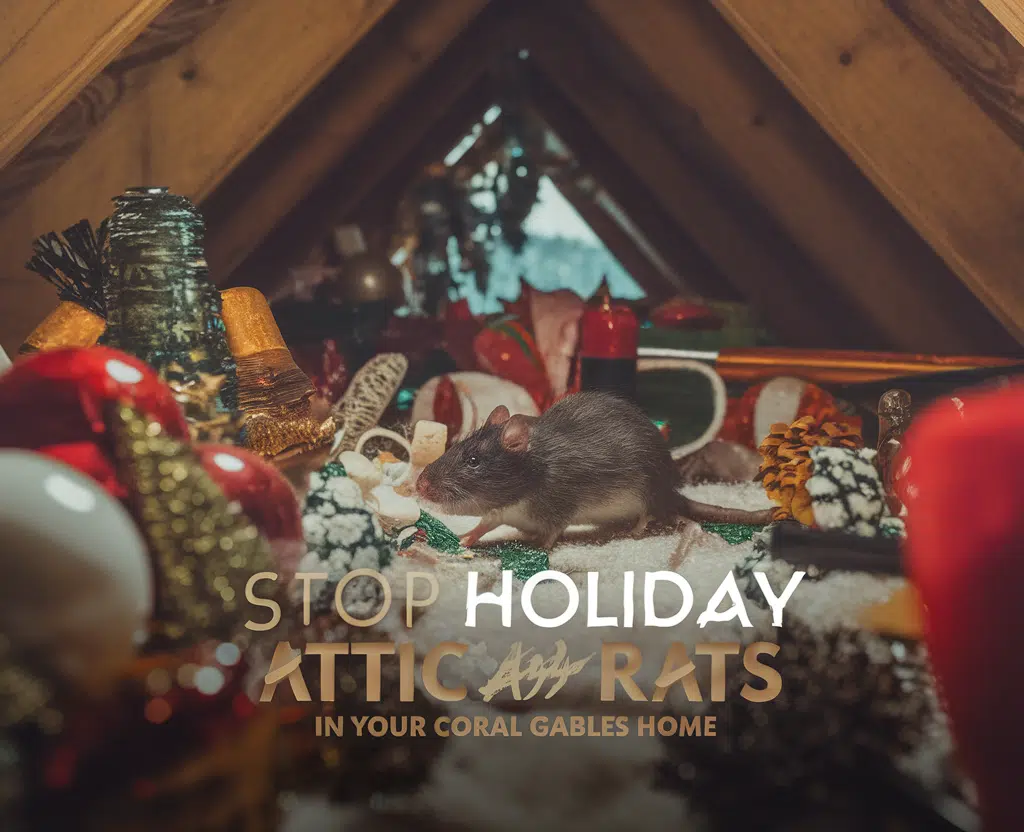
Picture this: It’s the first weekend of December, and you’re finally ready to transform your Coral Gables home into a holiday wonderland. You pull down the attic ladder, climb up with flashlight in hand, and immediately freeze. Something’s not right. Those storage boxes you carefully packed away last January? They’re shredded. The corner where you stored your grandmother’s vintage ornaments? It’s covered in dark droppings. And then you hear it: a scratching sound from somewhere deep in the rafters.
Your heart sinks. You’ve got rats.
If this scenario sounds familiar, you’re not alone. Every year, homeowners throughout Coral Gables, Pinecrest, and surrounding Miami-Dade neighborhoods face the same unwelcome discovery. The holiday season, which should be filled with festive decorations and family gatherings, becomes overshadowed by a pest problem that feels overwhelming and more than a little unsettling.
Here’s the thing: rat infestations aren’t just about the “ick factor” (though let’s be honest, that’s real enough). These uninvited guests pose genuine risks to your family’s health, your home’s structural integrity, and your peace of mind. But understanding why Coral Gables homes are particularly vulnerable during the holidays, and knowing what to do about it, can make all the difference between a minor inconvenience and a major crisis.
Why Your Beautiful Coral Gables Home Is a Rat Magnet
Let’s talk about why rat problems seem so common in our corner of South Florida, especially during the holiday months. It’s not that Coral Gables homes are dirty or poorly maintained. In fact, it’s often the very things that make our community so beautiful that create the perfect conditions for rats to thrive.
Walk down any street in Coral Gables and you’ll see what makes this city special: those gorgeous, towering banyan trees creating natural canopies, the lush tropical landscaping that seems to burst with life year-round, and the stunning Mediterranean Revival architecture that gives the area its distinctive character. It’s breathtaking. It’s also, unfortunately, exactly what rats are looking for.
Those magnificent trees with branches stretching toward your roofline? They’re nature’s highway system for roof rats, who are exceptional climbers. The dense bougainvillea cascading down your walls? Perfect cover for rats making their way to your eaves. The clay tile roofs that define so much of Coral Gables’ historic architecture? Over time, tiles shift, crack, or come loose, creating entry points that rats can exploit.
And then there’s the climate factor. While we don’t experience the harsh winters that send northern homeowners scrambling for their heating bills, South Florida does get cooler between November and January. Those occasional cold fronts that have you reaching for a light jacket? They’re sending rats searching for warmer accommodations. Your heated attic, filled with cozy insulation and stored items perfect for nesting, looks like a five-star resort to a rat seeking shelter.
What many homeowners don’t realize is that the holiday season coincides with the shift from South Florida’s wet season to drier weather. As outdoor water sources become scarcer and the natural food supply changes, rats become more aggressive in their search for resources. That means they’re more likely to venture closer to your home, test potential entry points, and ultimately find their way inside.
The Warning Signs You Shouldn’t Ignore
Most homeowners in Kendall, Palmetto Bay, and throughout Miami-Dade County first discover their rat problem when they venture into the attic to retrieve holiday decorations. But by that point, rats have often been there for weeks, quietly causing damage and multiplying.
The good news is that rats leave plenty of clues about their presence. You just need to know what you’re looking for.
Listen to Your Home
Your house talks to you, especially at night when everything else is quiet. In Coral Gables’ peaceful residential neighborhoods, those sounds become even more noticeable. If you’re lying in bed at 10 PM and hear scratching, scurrying, or thumping sounds coming from your ceiling, your home is telling you something important.
Rats are nocturnal creatures, most active during the hours when you’re winding down for the evening or sleeping soundly. That scratching you hear around 4 AM? That’s not your imagination, and it’s not the house settling. That’s rats running along attic beams, gnawing on wood, or moving through your insulation.
Some homeowners tell us they heard these sounds but dismissed them, thinking they were caused by palm fronds scraping the roof or maybe a possum passing through. But rats create distinct patterns: regular activity in the same areas, night after night. If you’re hearing it consistently, it’s time to investigate.
Visual Evidence Never Lies
When you do venture into your attic (and we recommend you do this before pulling down holiday decorations), bring a good flashlight and look carefully. Rat droppings are one of the most obvious signs. They’re capsule-shaped, about half to three-quarters of an inch long, and you’ll typically find them along the routes rats regularly travel.
Fresh gnaw marks on wooden beams appear lighter than the surrounding wood. You might spot them on electrical wires (which is particularly concerning), on storage boxes, or even on PVC pipes. Rats’ teeth never stop growing, so they gnaw constantly to keep them filed down. Unfortunately, they’re not picky about what they chew.
Look for dark, greasy smear marks along walls and beams. These come from oils in rats’ fur as they repeatedly follow the same pathways. If you see disturbed insulation creating clear trails, or shredded materials gathered in corners, you’re looking at nesting sites.
Here’s something that surprises many homeowners: grab a UV flashlight (you can pick one up inexpensively at most hardware stores) and scan your attic. Rat urine glows under UV light, revealing the extent of contamination that you can’t see with the naked eye. It’s not pleasant, but it’s information you need.
Don’t Forget the Exterior
Walk around your property and look up. Those tree branches hanging within six feet of your roofline? That’s an open invitation. Check your roof tiles, especially if you have one of Coral Gables’ beautiful older homes. Are any tiles displaced, cracked, or missing? Each one is a potential entry point.
Look for small holes or gaps where utility lines enter your home. Rats can squeeze through openings as small as a quarter. That gap that seems way too small to be a problem? A determined rat will prove you wrong.
If you have fruit trees (and many Coral Gables properties do), check the ground beneath them. Partially eaten fruit with distinctive gnaw marks means rats are actively feeding in your yard. From there, it’s a short journey to your attic.
What’s Really at Stake Here
Let me be straight with you: rats in your attic aren’t just an unpleasant nuisance. They represent genuine threats to your family and your property. And these threats escalate quickly.
A single female rat can produce up to 60 offspring in a year. That scratching sound you’re hearing in November? If left unchecked, it could be a colony of dozens by February. This isn’t meant to scare you, but rather to help you understand why early action matters so much.
Your Family’s Health Comes First
Rats carry diseases. It’s an uncomfortable truth, but one that homeowners throughout South Miami, Cutler Bay, and the rest of Miami-Dade County need to understand. Direct contact with rat urine or droppings can transmit leptospirosis, salmonellosis, and other serious illnesses. But you don’t need direct contact to be at risk.
When your HVAC system runs, it can pull contaminated air from your attic and circulate it throughout your home. Rat dander and dried urine particles become airborne, potentially triggering asthma attacks and allergic reactions, especially in children and elderly family members.
And those holiday decorations you’re about to bring down from an infested attic? Every box you handle could be contaminated with rat waste. Suddenly, decorating for the holidays becomes a health hazard instead of a joyful family tradition.
The Financial Reality
Here’s something that keeps pest control professionals up at night: rats are responsible for up to 25% of house fires of unknown origin. When rats chew through electrical wiring (which they frequently do), they create short circuit risks that can spark fires inside your walls or attic.
But fire risk is just the beginning. Rats will chew through your HVAC ductwork, destroying efficiency and requiring expensive repairs. They’ll tunnel through your attic insulation, compressing it and dramatically reducing its effectiveness. In Miami-Dade County, where air conditioning represents your largest energy expense, damaged insulation means your cooling costs skyrocket.
The average cost to repair rat damage in an attic ranges from $2,000 to $8,000. That includes contaminated insulation removal, sanitization, structural repairs, and replacing what the rats destroyed. Some homeowners we’ve worked with in Homestead and Richmond West have faced even higher costs when rats caused water damage by chewing through plumbing or created roof leaks.
Every week you wait to address a rat problem, the damage accumulates and the population grows. What could be resolved relatively inexpensively today might require extensive remediation tomorrow.
Why the Holidays Make Everything Worse
There’s a reason rat problems seem to peak during the holiday season, and it goes beyond just the cooler weather driving them indoors.
Think about what’s happening in your home right now. You’re cooking more, which means more aromatic smells wafting through your house and potentially into the attic. Those delicious holiday scents that you love? Rats find them equally appealing.
You might have houseguests staying over, which means you’re less likely to investigate strange sounds. After all, with people moving around at different hours, how can you tell what’s normal noise and what’s rats? And honestly, discovering a rat problem while hosting family for the holidays is awkward. Many homeowners tell us they knew something was wrong but didn’t want to deal with it until guests left.
Your attic is probably packed with storage right now: holiday decorations, seasonal items, boxes of memories. All of that provides perfect hiding spots and nesting materials for rats. The more cluttered your attic, the harder it is to spot an infestation early.
And if you’re planning to travel for the holidays? Those few weeks when your home sits empty give rats uninterrupted time to establish themselves, explore further into your home, and multiply without any human disturbance to discourage them.
Protecting Your Home the Right Way
Now let’s talk about solutions, because understanding the problem is only half the battle. Protecting your Coral Gables home from rats requires a comprehensive approach that addresses your specific property’s vulnerabilities.
Start With Your Landscape
I know those gorgeous trees and lush vegetation are part of why you love living in Coral Gables, Country Walk, or The Crossings. You don’t need to clear-cut your property, but strategic trimming makes a huge difference.
Get those tree branches at least 6 to 8 feet away from your roofline. Yes, it might temporarily affect your shade canopy, but trees grow back. Rat damage is permanent.
If you have climbing vines like bougainvillea, keep them from reaching your roof. They’re beautiful, but they’re also perfect ladders for rats. Similarly, dense ground cover right against your foundation provides hiding spots for rats as they explore your property’s perimeter. Create a three-foot clear zone around your home’s base.
For those of you with fruit trees (mango, avocado, citrus, and other varieties that thrive in Miami-Dade County), harvest regularly and clean up fallen fruit promptly. I know it’s tempting to let nature take its course, but decomposing fruit is a rat buffet.
Seal Every Entry Point
This is where many DIY efforts fall short. Rats can squeeze through openings as small as a quarter. Finding and properly sealing every potential entry point requires professional expertise, especially on Coral Gables’ complex Mediterranean architecture.
Those decorative architectural elements that make your home beautiful? They often create gaps and crevices that are easy to overlook but perfect for rats. Roof tiles need regular inspection and replacement when damaged. Vents require proper screening with quarter-inch hardware cloth (regular window screen won’t stop a determined rat).
Utility penetrations where pipes, wires, and cables enter your home need to be sealed with materials rats can’t chew through. Copper mesh works well because rats can’t gnaw through it, but it needs to be installed correctly and combined with appropriate sealants.
Eliminate What Attracts Them
Take a critical look at your property through a rat’s eyes. What’s available to eat? Where can they find water?
Pet food left outside overnight is an open invitation. Bird feeders that spill seed on the ground create feeding stations for rats, not just birds. Garbage cans without tight-sealing lids advertise food availability. Outdoor plumbing leaks provide water sources during the dry season.
Inside your home, store pantry goods in airtight containers, especially during the holiday baking season when you’re stocking up on flour, sugar, and other staples. Clean up immediately after meal preparation instead of letting dishes sit overnight. And those holiday decorations? Store them in sealed plastic containers instead of cardboard boxes that rats can easily chew through.
When Professional Help Isn’t Optional
Look, I appreciate the DIY spirit. There’s a lot you can do to protect your home, and the preventive measures we’ve discussed are important for every homeowner in Pinecrest, Glenvar Heights, and throughout our service area to implement.
But here’s the reality: if you already have rats in your attic, DIY solutions rarely work effectively. I’ve seen too many homeowners in Naranja, Silver Palm, and Riviera spend weeks trying to handle the problem themselves, only to end up calling us after the situation has gotten worse and more expensive to fix.
Why do DIY approaches fall short? Let’s be honest about the challenges.
First, there’s the access issue. Coral Gables’ Mediterranean-style homes often feature steep tile roofs that are genuinely dangerous to navigate without proper safety equipment and training. Climbing up there with a hardware store ladder is a recipe for a trip to the emergency room.
Second, identifying all the entry points requires professional experience. Rats don’t just use one hole. They often have multiple entry routes, and missing even one means the problem continues. We’ve conducted inspections where we found eight or ten separate entry points on a single property, each one needing specialized sealing techniques based on its location and the materials involved.
Third, there’s the population question. If you hear scratching, how many rats are up there? Two? Twenty? Over-the-counter traps might catch one or two rats, but if you have an established colony, you need a systematic approach. And if you use poison without professional guidance, rats can die in inaccessible wall voids, creating odor problems that last for weeks.
Fourth, killing the existing rats without proper exclusion work doesn’t solve anything. New rats will simply move into the territory, attracted by the same conditions that drew the first ones. You need both population control and exclusion to truly solve the problem.
What Professional Rat Control Actually Looks Like
When homeowners throughout Little Gables, Redland, and Princeton call Dade Pest Solutions, they often ask what the process actually involves. It’s a fair question, and the answer matters because effective rat control is systematic, not random.
We start with a comprehensive inspection of your entire property, inside and out. That means a thorough examination of your attic to assess population size, damage extent, and contamination levels. We inspect your home’s exterior perimeter, identifying every current and potential entry point. We evaluate your landscape, noting vegetation and other conditions that provide rat access or harborage. And we document everything with photos, so you can see exactly what we’re seeing and understand our recommendations.
Based on that inspection, we develop a customized treatment plan specific to your property. There’s no one-size-fits-all solution because every Coral Gables home is different. Your historic Mediterranean Revival house presents different challenges than your neighbor’s contemporary construction, and your mature landscape creates different access points than a newly developed property.
The treatment plan typically includes several components working together. Exclusion work seals entry points using materials appropriate for your home’s architecture: metal flashing for tile roofs, hardware cloth for vents, expandable foam with copper mesh for smaller gaps. Population reduction involves strategic placement of traps or bait stations in active areas, with regular monitoring and removal of dead rats to prevent odor issues. Sanitation services address contaminated insulation, cleaning affected areas with professional disinfectants, and removing waste accumulation. And we install permanent monitoring stations that allow ongoing assessment without continuous treatment.
Here’s what you can realistically expect in terms of timeline: initial population control usually takes 2 to 4 weeks for significant reduction in activity. Complete elimination typically requires 4 to 8 weeks depending on population size and property complexity. Exclusion work might take 1 to 3 visits to properly seal all entry points. Sanitation and repair get scheduled after population control, usually requiring 1 to 2 days. And ongoing monitoring happens quarterly to maintain your rat-free status.
Frequently Asked Questions About Attic Rats
How do I know if I have rats or just mice?
This is one of the most common questions we hear, and the distinction matters because treatment approaches differ slightly. Rats are significantly larger than mice, typically 7 to 10 inches long not counting the tail. Their droppings are correspondingly larger (around half to three-quarters of an inch) compared to mouse droppings (about a quarter inch). Rats make louder, more noticeable sounds, and the damage they cause is more substantial. If you’re hearing thumping sounds in your attic or seeing gnaw marks on wooden beams, you’re almost certainly dealing with rats rather than mice.
Can’t I just use poison from the hardware store?
Technically, yes, you can buy rat poison, but this approach creates several serious problems. First, poisoned rats often die in inaccessible locations inside your walls or attic, creating terrible odors that can last for weeks as the bodies decompose. Second, improper poison placement can endanger pets and children. Third, rats that consume poison and then go outside can poison predators like hawks and owls that eat them, harming the local ecosystem. Fourth, poison alone doesn’t address the entry points, so new rats simply move in. And finally, if not used correctly, rats can develop bait shyness, making future control efforts more difficult. Professional treatment uses poison strategically as one component of a comprehensive approach, not as a standalone solution.
How quickly do rats reproduce?
Unfortunately, very quickly. A female rat reaches sexual maturity at about 8 to 12 weeks of age and can produce 5 to 7 litters per year, with each litter containing 6 to 12 pups. Do the math and you’ll see why a small problem can become a major infestation in just a few months. This is why early intervention matters so much. That pair of rats you hear in November could theoretically become a colony of 50 or more by spring if left unchecked.
Will rats leave on their own when the weather warms up?
This is a dangerous misconception. While seasonal weather changes influence rat behavior, once rats have established themselves in your attic, they’ve found reliable shelter, potential food sources, and safe nesting sites. They have no incentive to leave just because the outdoor temperature rises a few degrees. The problem won’t resolve itself. Without intervention, rat populations grow and the damage accumulates regardless of the season.
Are rats common in new homes or just older properties?
Both, actually. Older homes in historic Coral Gables neighborhoods often have more potential entry points from decades of settling and wear, but newer construction isn’t immune. Contemporary homes feature complex rooflines with multiple peaks and valleys, recessed lighting that creates attic penetrations, attached garages providing secondary access routes, and landscaping that matures quickly in South Florida’s climate. We work with homeowners in both historic and newly developed areas throughout Miami-Dade County, and rat problems cross all property age categories.
How much does professional rat control cost?
This varies significantly based on the severity of the infestation, the size and complexity of your property, the extent of exclusion work needed, and whether sanitation and repairs are required. A straightforward treatment for a small infestation with minimal entry points might cost several hundred dollars, while extensive infestations requiring significant exclusion work, contaminated insulation removal, and ongoing monitoring could run several thousand dollars. That said, addressing the problem early is always less expensive than waiting. The cost of professional treatment is almost always lower than the cost of repairing extensive rat damage after the problem has escalated. We provide detailed estimates after inspection so you know exactly what to expect with no surprises.
Can I stay in my home during treatment?
Absolutely. Modern rat control methods are safe for occupied homes when performed by professionals. We use targeted treatments in attic spaces and other affected areas while your family goes about normal routines in the living spaces below. You don’t need to vacate your property, and there’s no need for extensive preparation beyond providing access to affected areas. We work around your schedule and minimize disruption to your household.
What happens after the rats are gone?
This is where the ongoing relationship becomes valuable. After we’ve eliminated the existing rat population and sealed entry points, we recommend quarterly monitoring services to ensure your home stays protected. South Florida’s conditions that attracted rats initially don’t disappear, so ongoing vigilance matters. Monitoring visits check the perimeter for new potential entry points, verify that previous exclusion work remains intact, and catch any new activity before it becomes a full-blown infestation. Think of it like routine maintenance that protects your investment and gives you peace of mind.
Your Holiday Season Deserves Better
It’s early evening in Coral Gables. The temperature has dropped to a pleasant 70 degrees, perfect for sitting on your patio with family. Holiday lights twinkle along your roofline. Inside, your home smells like the cookies you just pulled from the oven. Your decorations look beautiful, retrieved from an attic you know is clean and pest-free.
This is how the holiday season should feel. Peaceful. Joyful. Free from worry about what might be scratching around in your attic at 3 AM.
The truth is, rat problems are common in our beautiful corner of South Florida, but they’re also completely solvable. The unique characteristics that make Coral Gables such a wonderful place to live do create conditions rats find attractive, but understanding those conditions and taking appropriate action puts you back in control.
Early intervention makes all the difference. That minor scratching sound you’re noticing now can be resolved quickly with minimal expense and disruption. Wait a few months, and you might be looking at extensive repairs, contaminated insulation removal, and weeks of treatment.
At Dade Pest Solutions, we’ve been protecting homes throughout Miami-Dade County for years, and we understand the specific challenges that Coral Gables properties face. We’ve worked in every neighborhood, from the historic Granada Golf Course area to newer developments, and we’ve seen every variation of rat problem this region presents. More importantly, we’ve solved them.
We’re not just about eliminating current rat populations, though we do that effectively. We’re about understanding your home’s specific vulnerabilities, implementing solutions that work with your property’s unique architecture and landscaping, and creating long-term protection that prevents problems from returning. It’s the difference between a quick fix that provides temporary relief and a comprehensive solution that gives you lasting peace of mind.
Whether you’ve heard suspicious sounds, found evidence during a recent attic visit, or simply want to ensure your home is protected before problems start, we’re here to help. We serve homeowners throughout Coral Gables, Country Walk, Cutler Bay, Glenvar Heights, Homestead, Homestead Base, Kendall, Little Gables, Naranja, Palmetto Bay, Pinecrest, Princeton, Redland, Richmond West, Riviera, Silver Palm, South Miami, and The Crossings with the same commitment to quality and customer care.
This holiday season, don’t let attic rats steal your joy, threaten your family’s health, or damage your valuable property. Contact Dade Pest Solutions today for a thorough inspection and customized treatment plan designed specifically for rat control and exclusion in South Florida homes. Your Coral Gables home deserves protection, and we’re here to deliver it. Don’t let rats ruin your holidays. Call us now and get back to enjoying what matters most: time with the people you love in a home that’s truly yours.

17 Years of Pest Control Experience Founder and Owner of Dade Pest Solutions Proud Resident of South Florida
Shaun Judy, a dedicated South Florida native, is the founder and driving force behind Dade Pest Solutions. With over 17 years of hands-on experience in the pest control industry, Shaun has built a reputation for reliability, results, and real local knowledge. His journey began with a deep commitment to protecting homes from pests using proven methods and innovative solutions. Raised with a strong work ethic and a passion for service, Shaun treats every property as if it were his own—delivering expert care with a personal touch.