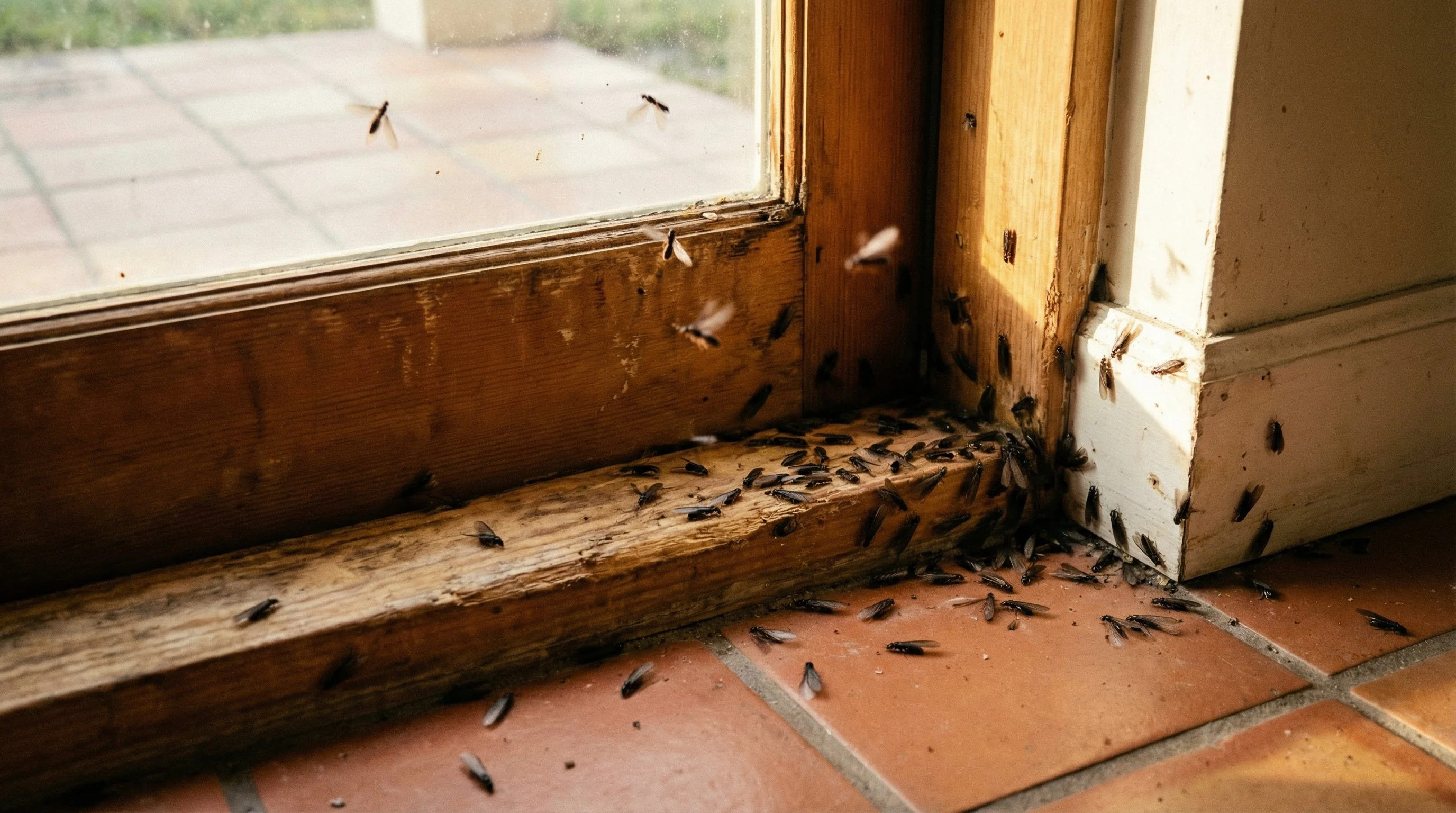

Every spring, I get a wave of calls from homeowners across Miami-Dade who have just seen something they have never seen before: dozens, sometimes hundreds, of small winged insects pouring out of a wall, a window frame, or the soil around their foundation. Most of them have no idea what they are looking at. Some think it is flying ants. Some think it is a one-time thing that will go away on its own.
It is not. What they are seeing is a termite swarm, and it is one of the most important warning signs a homeowner can receive. I have been doing pest control in South Florida for over 20 years, and I will tell you straight: if you see swarmers inside your home, there is already an active colony established somewhere in or under your structure. The swarmers are not the problem. They are the symptom.
This guide covers everything you need to know about termite swarm season in Miami-Dade: when it happens, which species are responsible, how to tell swarmers from flying ants, what the warning signs of an active infestation look like, and exactly what steps to take the moment you see them. I am writing this as a licensed pest control operator who has inspected thousands of South Florida homes, not as a marketing piece. My goal is to give you the information you need to protect your home.
1. Why Spring Is the Most Dangerous Time of Year for Termites in South Florida
South Florida has one of the highest termite pressures of any region in the United States. The University of Florida IFAS Extension confirms that Florida has more termite species than any other state in the continental U.S. The combination of year-round warmth, high humidity, frequent rain, and abundant wood sources creates conditions that termite colonies thrive in. But spring is when things escalate. As temperatures climb and the first heavy rains of the season arrive, mature termite colonies release their reproductive members, called alates or swarmers, to start new colonies.
In Miami-Dade, subterranean termite swarms typically begin in March and peak in April and May. Formosan termite swarms, which are larger and more dramatic, run from May through June and almost always happen at night near light sources. Drywood termites can swarm year-round but are most active in late summer. What this means for homeowners is that from March through July, you should be paying close attention to any unusual insect activity around your home, especially near windows, doors, and light fixtures.
Why This Matters
A single subterranean termite colony in South Florida can contain 200,000 to 2 million workers. By the time a colony is large enough to swarm, it has typically been feeding on your home's wood for three to five years. The swarm is not the beginning of the problem. It is the sign that the problem has been growing for years.
The timing of swarms is triggered by specific environmental conditions. For subterranean termites, a warm day following a rain event is the classic trigger. You will often see them in the late afternoon or early evening, emerging from the soil or from mud tubes along your foundation. Formosan termites are more dramatic: they emerge in massive numbers after dark, typically on warm, calm nights in May and June, and they are strongly attracted to light. If you have ever seen a cloud of insects around a streetlight or porch light on a warm spring night in Miami, there is a good chance you were watching a Formosan swarm.
2. Termite Swarmers vs. Flying Ants: How to Tell Them Apart
This is the question I get most often during swarm season, and it is an important one because the response is very different. Flying ants are a nuisance. Termite swarmers are a structural emergency. Here is how to tell them apart.
| Feature | Termite Swarmers | Flying Ants |
|---|---|---|
| Waist | Straight, thick, no pinch | Clearly pinched, narrow |
| Wings | Two pairs, equal length, shed easily | Two pairs, front longer than rear, stay attached |
| Antennae | Straight, beaded | Bent at 90 degrees (elbowed) |
| Body color | Dark brown to black | Varies, often reddish or black |
| Wing shed | Yes, wings break off at base | No, wings stay on |
| Concern level | High — call a pro immediately | Low — nuisance only |
The single most reliable field identification tip I give homeowners is this: look at the waist and look at the wings. Termite swarmers have a thick, straight waist with no pinch between the thorax and abdomen. Flying ants have a very obvious narrow pinch at the waist. If you find a pile of shed wings near a window sill, a door frame, or a light fixture, that is almost always termites. Ants do not shed their wings the way termites do.
If you are still not sure, collect a few in a small sealed bag or take a clear close-up photo and send it to us. We will identify them for free. Do not spray them with a consumer insecticide. Spraying swarmers will kill the ones you can see, but it will not touch the colony, and it will scatter them in ways that make the inspection harder. Just collect a sample and call.
3. The Three Termite Species You Need to Know in Miami-Dade
South Florida is home to three primary termite species that cause structural damage to homes. Each one behaves differently, swarms at different times, and requires a different treatment approach. Knowing which species you are dealing with is essential to choosing the right response.
Eastern Subterranean Termite
Reticulitermes flavipes
Swarm Time
March through May, late afternoon after rain
Entry Point
Soil contact, mud tubes along foundation, expansion joints
Damage Pattern
Attacks structural wood from the ground up, hollows out beams and joists
Treatment Approach
Liquid termiticide barrier or bait station system
Field Note from Shaun
The most common termite in Florida and the one responsible for the most structural damage. A mature colony can consume a foot of 2x4 lumber in approximately 5 months.
Formosan Subterranean Termite
Coptotermes formosanus
Swarm Time
May through June, at night near lights
Entry Point
Soil contact, aerial nests in moisture-damaged wood, roof structures
Damage Pattern
Extremely aggressive — can damage a structure faster than any other termite species
Treatment Approach
Liquid termiticide barrier combined with bait stations; aerial nests require direct treatment
Field Note from Shaun
Formosan colonies can reach 8 million workers. They are the most destructive termite in the world. If you see a large swarm at night near lights in May or June, treat it as an emergency.
Drywood Termite
Cryptotermes brevis and Incisitermes snyderi
Swarm Time
Year-round, peaks in late summer
Entry Point
Direct wood entry through cracks, joints, and exposed wood surfaces — no soil contact needed
Damage Pattern
Attacks dry wood including furniture, door frames, window frames, and roof structures
Treatment Approach
Localized treatment for small infestations; tent fumigation for widespread infestations
Field Note from Shaun
Drywood termites leave small piles of frass (fecal pellets) that look like sawdust or coffee grounds near infested wood. If you see this, do not sweep it up before calling us — it is evidence.
4. Warning Signs of an Active Termite Infestation
Swarmers are the most visible sign of a termite problem, but they are not the only one. In fact, by the time you see swarmers, the colony has usually been active for several years. Here are the other warning signs I look for during a termite inspection, and what each one tells me about the severity of the infestation.
Mud tubes on foundation walls or interior walls
Subterranean termites build pencil-width mud tubes to travel between the soil and wood without exposure to air. Finding a mud tube on your foundation is definitive evidence of an active or recent infestation. Break it open: if it is repaired within a few days, the colony is still active.
Hollow-sounding wood when tapped
Termites eat wood from the inside out, leaving a thin shell of paint or wood on the surface. Tap along baseboards, door frames, and window sills with a screwdriver handle. A hollow sound or a soft, papery feel means the wood has been compromised.
Frass (termite droppings) near wood surfaces
Drywood termites push their fecal pellets out of small kick-out holes. The pellets are tiny, about the size of a grain of sand, and look like sawdust or coffee grounds. Finding frass near a door frame, window sill, or piece of furniture is a reliable indicator of drywood termite activity.
Tight-fitting doors or windows that suddenly stick
As termites damage the wood framing around doors and windows, the structural integrity changes and the frames can warp or shift. If a door or window that used to open easily now sticks, especially during dry weather when wood should be contracting, termite damage is one possible cause.
Shed wings near windows, doors, or light fixtures
Termite swarmers shed their wings almost immediately after landing. Finding a pile of small, equal-length wings near a window sill or door threshold is one of the clearest signs that swarmers have entered your home from an active colony.
Visible damage to wood in crawl spaces or attic
If you have access to your attic or crawl space, look for wood that appears to have been eaten in a honeycomb pattern following the grain. Subterranean termites eat the soft spring wood and leave the harder summer wood, creating a characteristic layered appearance.
One thing I want to be clear about: you do not need to see all of these signs to have a serious termite problem. In many cases, homeowners see none of these signs until significant damage has already occurred. That is why annual termite inspections are so important in South Florida. The earlier we catch an infestation, the less it costs to treat and repair.
5. What To Do the Moment You See Termite Swarmers
I want to give you a clear, step-by-step protocol for what to do if you see swarmers, because the actions you take in the first 24 to 48 hours can significantly affect the outcome of the inspection and treatment.
Do not spray them
I know the instinct is to grab a can of Raid. Resist it. Consumer insecticides will kill the swarmers you can see, but they will not penetrate the colony, and they will cause the remaining swarmers to scatter to other parts of the structure. This makes it harder to locate the colony and can spread the infestation.
Collect a sample
Put a few swarmers in a sealed plastic bag or take several clear close-up photos. This helps us identify the species immediately, which determines the treatment approach. Subterranean termites, Formosan termites, and drywood termites require different treatments.
Note where they came from
Try to identify the emergence point. Are they coming from the soil near the foundation? From a crack in the baseboard? From a window frame? From the ceiling? This information is extremely valuable to the inspector and can cut the inspection time significantly.
Call a licensed pest control operator
Not a handyman. Not a general contractor. A licensed pest control operator who is certified in termite control. In Florida, termite work requires a separate certification (Category 9 under FDACS). At Dade Pest Solutions, every termite inspection is performed by a certified operator, not a sales rep.
Schedule an inspection within 48 hours
Termite damage is progressive. Every day the colony continues feeding, the damage gets worse. Most reputable companies can get you an inspection within 24 to 48 hours during swarm season. If a company tells you it will be two weeks, call someone else.
One more thing: if you see swarmers outside your home but not inside, that is still worth paying attention to. It means there are active colonies in your yard or in neighboring properties, and your home is at risk. This is a good time to schedule a preventive inspection and consider a termite protection plan before an infestation establishes itself inside your structure.
6. How to Reduce Your Home's Termite Risk This Season
There is no way to make a South Florida home completely immune to termites. The pressure is too high and the species too aggressive. But there are meaningful steps you can take to reduce your risk and make your home a harder target. I recommend all of these to every homeowner I work with.
Eliminate wood-to-soil contact
Any wood that touches the soil is a direct highway for subterranean termites. This includes wood mulch against the foundation, wooden fence posts set in soil, deck boards that contact the ground, and firewood stacked against the house.
Fix moisture problems immediately
Termites are attracted to moisture. Leaking pipes, poor drainage, clogged gutters, and condensation from AC units all create conditions that accelerate termite activity. Fix every moisture source you can find.
Seal cracks and gaps in the foundation
Subterranean termites can enter through a crack as narrow as 1/64 of an inch. Seal expansion joints, pipe penetrations, and any visible cracks in your foundation with a concrete sealant or foam backer rod.
Keep attic and crawl spaces ventilated
Moisture accumulation in attic spaces and crawl spaces creates ideal conditions for both subterranean and drywood termites. Make sure vents are clear and functioning, and address any standing water or condensation issues.
Remove dead wood and debris from your yard
Tree stumps, dead roots, construction debris, and old lumber left in the yard are all food sources that can support a growing termite colony before it moves to your home.
Schedule an annual termite inspection
This is the single most effective thing you can do. A trained inspector will catch early-stage infestations before they become expensive structural problems. In South Florida, annual inspections are not optional — they are essential.
At Dade Pest Solutions, our Termite Risk Mitigation Plan combines a full inspection, a customized treatment plan, preventive barrier installation, and annual monitoring visits. It is designed specifically for South Florida conditions and the three termite species we deal with here. If you have never had a termite inspection or if it has been more than a year since your last one, now is the time.
The Bottom Line on Termite Swarm Season
Spring swarm season in South Florida is not something to take lightly. The termite species we deal with here are among the most destructive in the world, and the environmental conditions in Miami-Dade are essentially perfect for them year-round. The good news is that termite damage is almost entirely preventable with the right protection plan and regular inspections. Termites are not the only pest that ramps up in spring, either. If you want the full picture of what Miami-Dade homeowners face from March through October, our South Florida Pest Season 2026 guide covers ghost ants, mosquitoes, roof rats, and German roaches alongside termites.
If you see swarmers, do not wait. Call us at 305-330-5565 and we will get an inspector to your property within 24 to 48 hours. If you have not had a termite inspection in the past year, schedule one now before swarm season peaks. The cost of an inspection is a fraction of the cost of the repairs that a missed infestation can require.
I have been protecting South Florida homes from termites for over 20 years. I have seen what a mature Formosan colony can do to a roof structure, and I have seen homeowners face five-figure repair bills that could have been avoided with a $150 inspection. Do not let that be your story.
Shaun Judy
Founder and CEO, Dade Pest Solutions
FDACS Certified Operator License JF293201
Serving Miami-Dade County since 2004
Frequently Asked Questions
Saw Swarmers? Call Us Now.
Our FDACS-certified inspectors serve all of Miami-Dade County. We can typically get to you within 24 to 48 hours during swarm season.