The Short Answer
Most professional pest control treatments have little to no odor. When you do notice a smell, it comes from the carrier solvents in the product, not the active ingredient that kills pests. The odor typically dissipates within 30 minutes to 2 hours with proper ventilation. It is not dangerous at normal exposure levels, and it does not indicate whether the treatment is working.
Shaun Judy
CEO & Licensed Operator, Dade Pest Solutions | FDACS License JF293201 | 17+ Years in South Florida Pest Management
This is one of the most common questions we get from homeowners, especially after their first professional treatment. You walk back into your home after service, and there is a faint chemical smell in the air. Is that normal? Is it safe? Should you be worried?
I want to give you an honest, straightforward answer because I think the pest control industry does a poor job of explaining this to customers. The short version: yes, some treatments have a smell. No, it is not dangerous. And no, the smell does not mean the treatment is stronger or more effective. Let me explain why.
What Actually Causes the Smell
Professional pest control products have two main components: the active ingredient (the part that controls pests) and the carrier (the liquid that delivers the active ingredient to the target area). The smell you notice almost always comes from the carrier, not the active ingredient itself.
Think of it like paint. The pigment in paint is what gives you color on the wall. The solvent is what makes it liquid enough to apply. As the paint dries, the solvent evaporates and you smell it temporarily. The same principle applies to many pest control products.
Modern professional products have evolved significantly. According to the U.S. Environmental Protection Agency (EPA), all registered pesticide products must meet strict safety standards before they can be sold or used in the United States. The products we use at Dade Pest Solutions are EPA-registered and applied according to label directions by FDACS-licensed technicians.
Common Sources of Pest Control Odor
- Water-based liquid concentrates: Very mild smell that dissipates in 15 to 30 minutes
- Solvent-based sprays: Stronger chemical smell, dissipates in 1 to 2 hours
- Gel baits: Virtually no odor at all
- Granular products: No noticeable odor
- Dust formulations: Minimal odor, applied in enclosed voids
- Fumigants (tent fumigation): Strong odor during treatment, completely dissipates after aeration
Which Treatments Smell the Most (and Which Have No Smell at All)
Not all pest control treatments are created equal when it comes to odor. Here is an honest breakdown based on what we actually use in the field:
Treatments with little to no odor
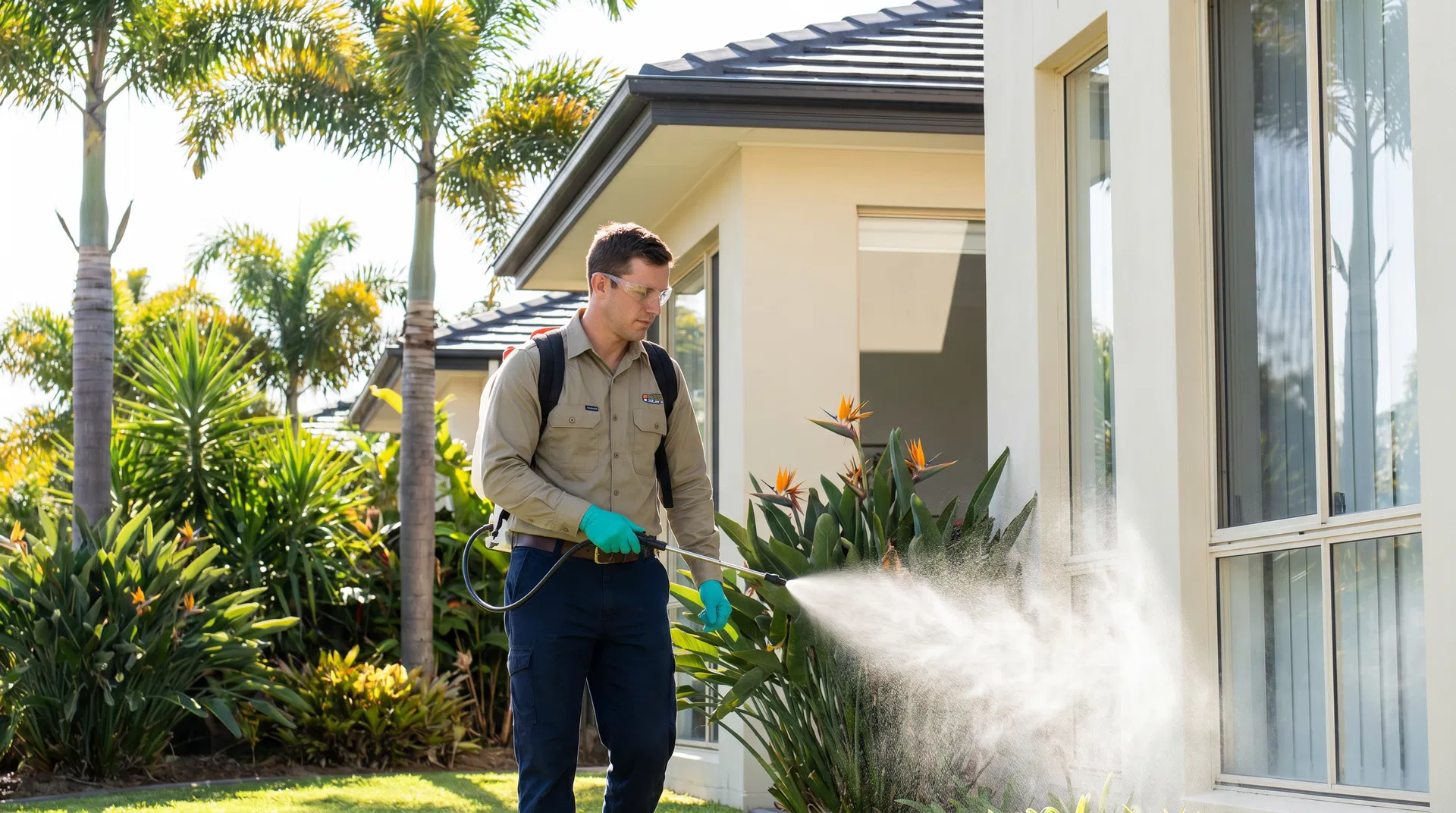
Our Residential Protection Program (RPP) quarterly treatments are primarily exterior perimeter applications using water-based products. Most customers cannot detect any smell at all from these treatments. The product dries on the exterior foundation within 15 to 20 minutes and has no indoor impact.
Gel baits used for cockroach and ant control are completely odorless. They are applied in small dots inside cabinets, behind appliances, and in cracks where pests travel. You will never smell these products.
Treatments with noticeable odor
Interior crack-and-crevice treatments for German roach infestations can produce a noticeable smell because the products are applied in enclosed spaces where air circulation is limited. This smell typically dissipates within 2 to 4 hours.
Termite soil treatments applied around a foundation have a distinct earthy chemical smell at the point of application. Since these are applied outdoors in the soil, the smell does not typically enter the home. If you are near the treatment area during application, you may notice it briefly.
Treatments with strong odor (temporary)
Tent fumigation (Vikane) involves sealing the entire structure and introducing a gas fumigant. Vikane itself is actually odorless, but a warning agent called chloropicrin (tear gas) is released first as a safety measure to ensure the home is vacated. After the aeration process is complete and the home is cleared for re-entry, there is no residual odor.
How to Reduce or Eliminate the Smell After Treatment
If your treatment does produce a noticeable odor, here are the most effective ways to clear it quickly:
- Open windows and exterior doors to create cross-ventilation. Even 15 minutes of fresh air circulation makes a significant difference.
- Run ceiling fans and floor fans to increase air movement. Point fans toward open windows to push treated air outside.
- Turn on your HVAC system with the fan set to "on" (not "auto"). This circulates air through your home and through the filter.
- Wait for surfaces to dry completely. Most odor comes from wet product. Once it dries, the smell stops.
- Do not use air fresheners to mask the smell. Let the product dry naturally. Masking the odor does not speed up the drying process.
When You Should Actually Be Concerned
In my 17 years of pest control experience, the vast majority of odor concerns are completely normal and resolve quickly. However, there are a few situations where you should contact your pest control provider:
- The smell persists for more than 24 hours after an interior treatment. This could indicate over-application or poor ventilation in a specific area.
- You experience respiratory irritation, headaches, or nausea. While rare with professional applications, some individuals are more sensitive to chemical odors. Leave the area and ventilate.
- You notice a strong smell from an area that was not treated. This could indicate a product spill or misapplication.
- The smell is accompanied by visible residue on surfaces where you eat, prepare food, or where children play.
If any of these situations occur, call your pest control company immediately. At Dade Pest Solutions, our call center is available 24/7 at (305) 330-5565 to address any concerns after treatment.
What I Tell Every New Customer
Before every first service, our technicians explain exactly what products they are using, where they are applying them, and whether there will be any noticeable odor. We believe you have the right to know what is being applied in and around your home.
If odor is a concern for you, tell us before service. We can almost always use low-odor or odor-free alternatives for routine treatments. The only exception is when a specific pest problem requires a particular product formulation, and in those cases, we will explain why and give you clear guidance on ventilation and re-entry timing.
The bottom line: a faint smell after treatment is normal, temporary, and not harmful. It does not mean the treatment is more effective, and its absence does not mean the treatment is less effective. Modern pest control has come a long way from the days of heavy-smelling sprays that filled entire rooms.
Frequently Asked Questions
Why does my house smell after pest control?
How long does the pest control smell last?
Is the smell from pest control dangerous?
Can I request odor-free pest control?
Does the smell mean the treatment is working?
Should I leave my house during pest control?
Have Questions About Your Treatment?
Our team is happy to explain exactly what products we use and what to expect. Call us at (305) 330-5565 or request a free estimate online.